
Ensuring factory authenticity in a global market requires moving beyond a surface-level review of supplier documents. A single fraudulent document can lead to severe financial losses and legal debarment, making a proactive verification strategy essential for any secure supply chain.
This guide provides a technical roadmap on how to confirm if a factory’s certificates are fake by identifying critical red flags. To confirm if certificates are fake, conduct a technical audit by checking file metadata for date discrepancies and cross-referencing unique IDs against official registries like the IAF database. Inspect documents for red flags such as pixelated seals or inconsistent typography, and always validate credentials directly through accredited issuing bodies to ensure total regulatory compliance.
Common Types of Fake Certificates
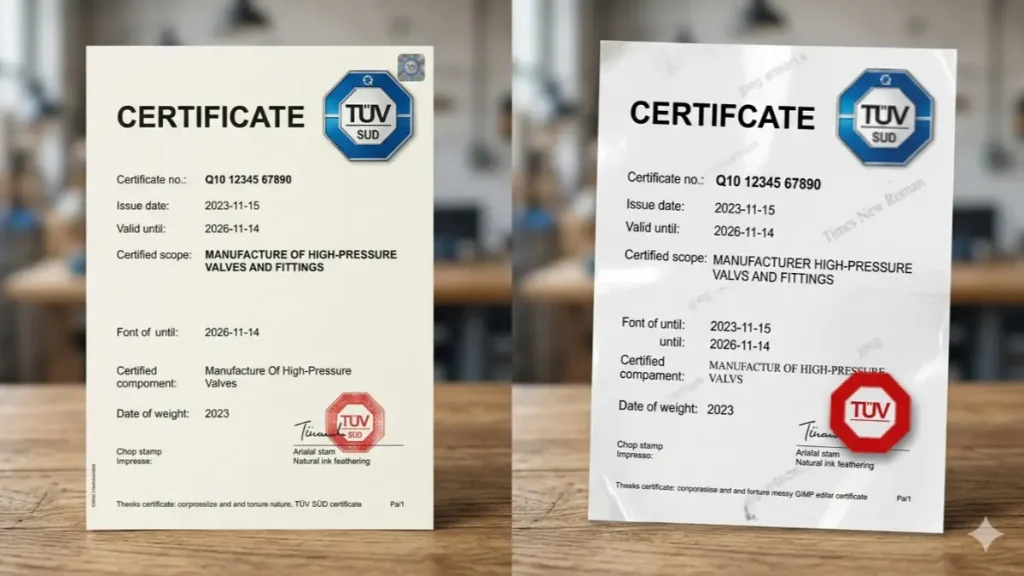
In international sourcing, a “certified” status is only as reliable as the verification behind it. Fake documents range from simple digital edits to sophisticated synthetic templates that mimic regulatory compliance. To protect your supply chain, procurement teams must look beyond the surface of a PDF to identify the technical markers of fraud.
Quick Check: 5 Direct Red Flags
- Metadata Mismatches: File properties show a “Created Date” that is years after the “Issue Date” on the certificate face.
- Typography Inconsistencies: Multiple font styles or mismatched font sizes within the same data field (e.g., the company name vs. the rest of the text).
- Visual Artifacts: Pixelated “Chop” stamps, blurry logos, or “halos” around text—common signs of Photoshop or GIMP manipulation.
- Verification Desync: Searching the unique certificate ID in official registries (like IAF CertSearch) returns “No Record Found.”
- Missing Security Physics: Scanned copies that lack visible security features like holograms, microprinting, or complex guilloche patterns.
Digital Manipulation and Metadata Traps
The most prevalent method of fraud involves altering genuine certificates using image-editing software. While these changes may look seamless to the naked eye, they often leave behind a digital trail. Professional auditors inspect the file’s internal edit history and software signatures; for instance, a PDF claiming to be a 2018 original that was actually saved in 2024 is a definitive indicator of fraudulent intent.
Falsified Conformity and Physical Security Failures
Beyond digital edits, some manufacturers utilize “credential mills” to produce counterfeit test reports that mimic accredited bodies. These forgeries often fail when subjected to magnification or light-reactive testing. Authentic certificates incorporate sophisticated security features—such as UV-glowing fibers and microprinting—that standard office printers cannot replicate. When a supplier provides a scan where the guilloche patterns are blurry or the embossed seals do not react to light, the document is likely a low-quality reproduction of a stolen template.
Methods to Cross-Check Against Official Databases
To effectively verify Chinese factories, buyers must bypass supplier-provided PDFs and cross-reference credentials against live, third-party registries. This direct validation ensures that management systems, safety listings, and regulatory filings are active and unaltered.
| Database Registry | Verification Focus | Search Identifiers |
|---|---|---|
| IAF CertSearch | ISO & Management Systems | Certificate ID, Client Name |
| UL Product iQ | Electrical & Safety Listings | CCN, File #, Assembly # |
| FDA Inspection Database | GMP Compliance Records | NAI, VAI, OAI Status Codes |
| EudraGMDP (EMA) | EU Manufacturing Sites | Competent Authority Data |
| IECEE Database | CB Scheme (Electronics) | National Body Certificate Extracts |
Registry Reconciliation: Never trust a PDF link provided by a vendor. Manually input the certificate ID into global databases like IAF CertSearch or the UL Product iQ. For China-specific oversight, cross-reference the document against the CNCA (Certification and Accreditation Administration of China) database to ensure the local issuer is officially licensed.
Metadata & Forensic Analysis: Inspect the digital “fingerprints” of the file. Use PDF forensic tools to check for metadata discrepancies—such as a document claiming 2020 issuance but showing a 2026 “Modified Date” in its properties. Look for “Edit Layers” or compression artifacts around the factory name and seal, which indicate Photoshop manipulation.
Direct Issuer Ping: When database records are ambiguous, send a “Verification of Authenticity” (VoA) request directly to the issuing body’s customer center (e.g., SGS, TÜV, or Intertek). Provide the report number and factory name to confirm the scope of the audit matches the product you are purchasing.
When to Use Third-Party Verification

To maintain a secure supply chain, Third-Party Verification (TPV) is the bridge between a factory’s claims and industrial reality. For a professional sourcing agent, utilizing TPV is no longer an optional safeguard but a legal necessity in high-risk sectors.
When TPV is Non-Negotiable
- Regulatory Compliance: Frameworks like FDA FSMA or 3-A Sanitary Standards mandate independent oversight. For example, a manufacturer cannot legally display the 3-A Symbol without a formal TPV inspection.
- High-Stakes Industries: In aerospace, defense, and medical electronics, TPV confirms that materials and assembly meet “mission-critical” safety standards.
- New Supplier Onboarding: When sourcing from regions with high rates of document fraud, TPV acts as the ultimate filter to prevent 6-figure financial losses.
The 3-Step Verification Protocol
Professional evaluators, such as the 27 accredited CCEs within the 3-A SSI framework, follow a rigorous technical roadmap:
- Documentation Deep-Dives: A granular review of material certifications, engineering drawings, and CIP/COP sanitation instructions.
- On-Site Physical Audits: Real-world inspection of material handling, quality control logs, and manufacturing tolerances.
- Credential Cross-Referencing: Validating the inspector’s own accreditation through ISO or FDA-recognized programs to ensure the audit’s legal standing.
Your Dedicated Boots on the Ground for China Sourcing

Phone/WeChat Verification Tips
To secure your supply chain, verifying the human behind the document is as critical as the certificate itself. In the Chinese market, identifying legitimate factory representatives requires deep technical integration with mobile networks and communication protocols.
Mobile Identity Validation
- HLR Real-Time Queries: Systems perform Home Location Register (HLR) lookups to confirm active carrier registration, ensuring the contact isn’t using a defunct or fake number.
- Non-VoIP Detection: We filter out anonymous “burner” accounts and virtual numbers. Legitimate B2B representatives use mobile numbers with verified portability history linked to registered identities.
- Behavioral Analysis: By analyzing network activity and number portability, we detect “account takeovers” where a fraudster might be impersonating a factory sales manager.
Security & Compliance Standards
- Certified Operations: Verification workflows adhere to SOC 2 Type II and ISO 27001, maintaining an immutable audit trail for every verification request.
- Identity Integrity: We utilize STIR/SHAKEN attestation to prevent caller ID spoofing and AES-256 encryption to protect sensitive client-factory dialogues.
- Global Reach: One-Time Password (OTP) systems with sub-200ms latency provide instant “proof-of-possession” for representatives in 200+ countries.
Warning Signs of Document Fraud
When a visual “quick check” isn’t enough, professional auditors use a forensic approach to uncover sophisticated document fraud. These red flags often confirm a “Database No Record” result before you even run the search.
Visual Forensic Markers
- Typography Inconsistency: Authentic certificates from bodies like TÜV or SGS use standardized, uniform font sets. Look for mismatched typefaces or “floating” text that isn’t perfectly aligned with the template lines—this is a clear sign of digital overlay.
- Stamp Artifacts: Official “Chop” stamps or red seals should show natural ink bleeding. If the edges are pixelated, blurry, or unnaturally clean, the stamp was likely “cut-and-pasted” from another PDF.
- Missing Security Physics: High-stakes certificates incorporate micro-text (smaller than 1mm) and watermarks. If these are invisible or appear as flat gray pixels in a high-res scan, the document is a reproduction.
Logical & Temporal Discrepancies
- Temporal Logic Failures: A common mistake in forgeries is setting an expiration date that exceeds the standard 3-year ISO cycle, or dates that logically precede the issue date.
- Metadata Desync: Digital file properties (the “hidden” data) must match the certificate face. If a 2018 certificate shows a “Modified Date” of 2026, the document’s integrity is compromised.
- Serial Number Anomalies: Each issuer follows a specific alphanumeric sequence. Deviations from these standard patterns indicate a template recycled from an unrelated industry.
Use this technical checklist to determine if a document requires immediate third-party escalation.
| Audit Layer | Critical Verification Action | Pass/Fail Criteria |
|---|---|---|
| Optical Check | Zoom into “Chop” stamps and text boundaries at 400% magnification. | FAIL: If text “floats” or stamp edges show pixelated white halos. |
| Temporal Audit | Compare the certificate “Modified Date” in PDF properties vs. Issue Date. | FAIL: If metadata shows a 2024 save date for a 2018 original. |
| Entity Match | Search the CNCA or IAF database using the Unique ID. | FAIL: If the registered company name differs from the PDF name. |
| Security Check | Verify the presence of microprinting and standard watermarks. | FAIL: If background patterns are blurry or non-reactive to light. |
What to Do If You Suspect a Fake
If you suspect a document is fraudulent, halt the procurement process immediately. The first defensive step is to formally request compliance documents from factory in their original, high-resolution PDF format. Do not accept screenshots or low-quality photos, as these are used to mask digital artifacts.
- Isolate the Unique ID: Extract the certificate number, issuance date, and listed scope. Cross-reference these against the supplier’s actual production capacity to ensure they align.
- Bypass Vendor Links: Never use verification URLs provided by the supplier. Manually navigate to IAF CertSearch for ISO claims or the specific issuer’s portal (e.g., SGS, TÜV).
- Direct Body Inquiry: Contact the issuing accreditation body directly. Provide the certificate ID and ask for a Verification of Authenticity (VoA).
- Verify the Accreditor: Ensure the body that granted the certificate is itself legitimate by checking national government registries or international accreditation forums.
Watch for “look-alike” acronyms designed to mimic reputable agencies. If the database returns “No Record Found” or the name on the registry differs from the PDF, you have confirmed a high-probability forgery. Transitioning to a third-party on-site audit is the only way to recover the project safely.
Impact on Import & Compliance
Utilizing fraudulent factory certificates is a high-stakes gamble that extends far beyond product quality—it is a direct threat to your corporate survival.
Aggressive Customs Enforcement: Agencies like U.S. Customs and Border Protection (CBP) trigger immediate cargo detentions, post-entry audits, and formal seizures upon discovering doctored documentation.
Severe Financial Penalties: Forgeries often lead to HTS misclassification, resulting in 6-7 figure losses from regulatory fines and civil enforcement under the False Claims Act (FCA).
Administrative Debarment: Persistent documentation gaps can lead to the permanent loss of import privileges and global supply chain blacklisting.
Systemic Red Flags: Data discrepancies between international systems (e.g., US ACE, Germany’s ATLAS) trigger automated holds and physical exams.
To mitigate these risks, companies must maintain rigorous SOPs, including HTS memos and valuation support documents, to ensure a defensible record against DOJ scrutiny.
Final Thoughts
In today’s high-stakes sourcing landscape, verifying factory certificates is a matter of corporate survival. Relying on unverified PDFs exposes your business to cargo seizures, 6-7 figure fines, and permanent trade debarment. Ensuring document authenticity requires a proactive strategy of registry cross-checks and technical forensics to separate legitimate partners from fraudulent entities.
At ASG, we eliminate these risks by providing expert “boots on the ground.” Our team conducts rigorous, on-site audits and direct credential validation, ensuring your supply chain remains transparent and fully compliant. Secure Your Supply Chain with ASG.
Frequently Asked Questions
How do I verify if an FDA certificate is authentic?
For food and pharmaceutical certificates, scan the unique QR code on the document to access the official copy via the FECV portal. For medical devices, search the USFDA Search Registry using the owner or operator number to confirm the manufacturer’s legitimate registration.
What is the correct way to check a CE mark’s validity?
Request the EC Declaration of Conformity and verify the 4-digit Notified Body number in the European NANDO database. Additionally, request the manufacturer’s ISO 13485:2016 certificate and verify the issuing body through the IAF CertSearch portal.
Which official databases should I use for certificate verification?
Key databases include the USFDA Search Registry for medical devices, the FECV Portal for pharmaceutical exports, the NANDO database for EU CE marking, and IAF CertSearch for global ISO certifications.
Should I re-test products even if the factory provides certificates?
Yes. While certificates prove a factory’s capability, factory audits and third-party product re-testing are highly recommended for bulk orders. This ensures that the production-line reality matches the documentation and prevents ‘quality drift’ during manufacturing.



-300x198.png)


