Your supplier has been reliable for three years, with consistent quality, on-time deliveries, and smooth communication. Then delivery times stretch from 30 to 45 days, replies slow down, and minor defects recur. These changes may signal problems that need attention.
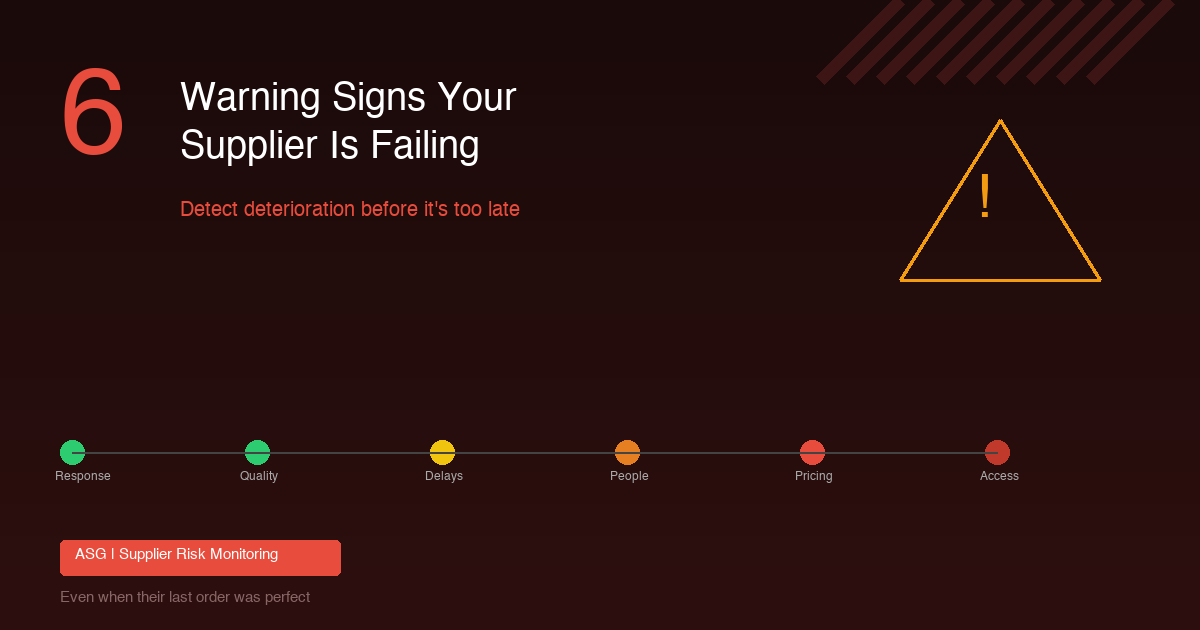
Supplier problems often develop gradually. This article covers six warning signs that a previously reliable supplier may be deteriorating. For risks during initial supplier selection, see our guide to 7 silent red flags buyers miss.
Drawing on 15 years of supplier relationship management across 30+ cities, we’ve identified six signs that help buyers spot potential problems early.
Why Good Suppliers Fail and Why Buyers Miss the Signs

The Trust Trap
The longer a supplier relationship lasts and the better their historical performance, the less monitoring effort buyers invest. The typical psychology: “We’ve worked together for 5 years, they’ve always been reliable, I don’t need to check every order.”
The reality: supplier failure usually has nothing to do with reliability. The causes are financial distress, management changes, personnel loss, or external shocks; none of which appear in delivery records or quality reports until the damage is already done.
The 4 Reasons Good Suppliers Deteriorate
| Root Cause | Description | Buyer Visibility |
|---|---|---|
| Cash flow breakdown | Slow customer payments, tightened bank credit, over-expansion | Low, suppliers never disclose this voluntarily |
| Key personnel loss | Your contact, QC manager, or production lead leaves | Medium, not immediately obvious |
| Management changes | Founder exits, partner disputes, next-gen succession | Low, internal decisions are opaque |
| External shocks | Environmental compliance shutdowns, trade friction, raw material spikes | Medium, traceable but often ignored |
The Visibility Gap
As an overseas buyer, your operational visibility into a supplier is extremely limited. What you see, quotes, delivery dates, quality reports, are lagging indicators. What matters more are the leading indicators you typically cannot see: cash flow, employee turnover rate, raw material procurement frequency, equipment maintenance status.
The six warning signs below are designed to extract leading indicators from the limited information channels available to overseas buyers.
Warning Sign #1, Response Time Gradually Slows Down

The signal:
- Emails that previously received replies within 4 hours now take 24-48 hours.
- Delivery confirmations that were immediate now require “internal verification”.
- Proactive progress updates have stopped, you now have to chase for information.
Why it matters: Slower response times typically indicate one of three things:
- Your orders have dropped in priority (they’re serving larger clients).
- Internal coordination efficiency has declined (staff shortages or management chaos).
- Your contact is overloaded or in transition (departure handover).
How to detect it: Track average response time across the last 6 months of communications. If the trend line moves from under 8 hours to over 24 hours, that’s a measurable signal, not a coincidence.
What to do: Don’t confront them directly (“Why are you responding slowly?”); this only produces polite excuses. Instead, request weekly progress updates. If they can’t even maintain that rhythm, the signal is confirmed.
Severity: ⚠️ Yellow, alone it’s a yellow flag. Combined with other signals, it escalates.
This connects to communication patterns you may have already noticed, our communication decoder guide explains what changes in communication style often signal beneath the surface.
Warning Sign #2, Consistent Small Quality Drift
The signal: Not sudden catastrophic failures, but small deviations in every order that weren’t there before. Colors slightly off from the approved sample. Packaging slightly looser. Edge finishing slightly rougher. Each individual order passes inspection; but the trend is downward.
Why it matters: Minor quality drift typically indicates:
- The supplier is substituting materials to maintain margins (cost cutting under financial pressure).
- Production workers are leaving and new hires lack proficiency.
- Equipment is aging without maintenance, precision degrades gradually.
- Management attention has shifted away from the production floor (likely dealing with a financial or administrative crisis).
How to detect it: Maintain inspection reports from the last 12 months and build a parameter trend table. Track: Is dimensional variance widening? Is AQL pass rate declining? Are cosmetic defect notes increasing? If three consecutive orders show “acceptable but noted” comments in inspection reports, that’s a confirmed signal.
What to do: Add DUPRO (During Production) inspections to your next order, checking quality at 50% production completion rather than only at final inspection. If mid-production quality is also declining, escalate the signal to orange.
Severity: 🟠 Orange, quality signals demand immediate action once confirmed. Our quality control team provides independent DUPRO and final inspections that maintain consistent measurement standards across orders.
Warning Sign #3, Frequent “Unusual” Delay Excuses

The signal: Delay reasons used to be standard (“peak season scheduling,” “raw material arrival delayed”). Now they’re becoming unusual:
- “Our factory had a power outage”.
- “Our primary raw material supplier had problems”.
- “We’re dealing with some legal matters”.
- “The factory needs to relocate”.
- “Our bank account had a temporary issue”.
Why it matters: These “unusual” reasons, when pieced together, often form a complete picture of a supplier experiencing serious operational crisis. Buyers tend to accept explanations and wait, because switching suppliers is costly. But each unusual excuse may correspond to: equipment seizure, broken supplier relationships, legal disputes, or cash flow collapse.
How to detect it: Maintain a “delay reason log” for every order. If you see 3+ unusual reasons within 12 months, that’s a strong signal. Watch for the “chain delay” pattern: one order delayed → next order delayed → the one after delayed again; this indicates worsening conditions, not recovery.
What to do: Independently verify each unusual reason:
- Power outage: Confirm the outage with the local utility company.
- Relocation: Request the supplier’s new address and photos of the new facility.
- Legal matters: Search Tianyancha or Qichacha for records of legal proceedings.
Simultaneously initiate backup supplier assessment. You don’t need to switch immediately, but having a validated Plan B changes your negotiating position from reactive to proactive.
Severity: 🔴 Red, frequent unusual delay reasons are among the strongest individual warning signals.
Warning Sign #4, Key Personnel Changes Without Proper Handover
The signal: Your primary contact (sales manager/project manager) leaves suddenly. The replacement doesn’t know your collaboration history. Previous communication records and agreements weren’t transferred. The new contact needs to re-confirm things already confirmed with the previous person.
Why it matters: In Chinese manufacturing, client relationships are highly personal. Your sales manager leaving could mean:
- Internal management problems (delayed salaries, leadership conflicts).
- Sales team restructuring or layoffs.
- The departed person went to a competitor or started their own company (and may try to redirect your orders).
Improper handover means the company’s knowledge management is weak, client information lives with individuals, not in company systems.
How to detect it: Did the new contact proactively reach out within 24 hours? Do they know your product specifications and historical order details? If the new contact is unaware of previously agreed prices, terms, or delivery schedules, that’s a serious signal.
What to do: Schedule a formal “collaboration review meeting” with the new contact, restate all agreements and special requirements. Require written re-confirmation of all existing terms. If the new contact hasn’t reached the previous person’s level within 30 days, escalate to red.
Severity: 🟠 Orange, single departure is orange. Multiple departures within 6 months escalates to red.
Warning Sign #5, Pricing Behavior Anomalies
The signal: Three anomalous patterns, each pointing to different problems:
| Anomaly Type | Pattern | Likely Cause |
|---|---|---|
| Abnormally low price | Quote suddenly 10%+ below market | Cash flow emergency, needs orders to maintain operations |
| Frequent price increases | Price adjustment requests every 2-3 months | Cost control failure or raw material procurement breakdown |
| Shortening quote validity | Quote validity shrinks from 30 days to 7 days | Extreme raw material volatility or supplier financial instability |
Why it matters: Abnormally low prices are the most misread signal, many buyers think “Great, a price reduction!” But suppliers have no rational reason to sell below cost. Low pricing usually means:
- They urgently need cash (your order keeps them afloat, paying wages or suppliers).
- They plan to cut corners on materials or processes to maintain margins.
- Their capacity utilization is critically low (other clients have already left).
The deposit escalation signal: If the supplier starts requesting higher deposit percentages (30% → 50% → 70%), this is the most direct financial pressure indicator. A healthy supplier doesn’t need increasing upfront cash from existing clients.
How to detect it: Build a price trend table tracking the same SKU across 12 months. Compare against public raw material price indices. If raw materials increased 5% but your supplier dropped prices 8%, that’s irrational; and therefore a signal.
Catch a Failing Supplier Before It Costs You a Shipment

What to do: For abnormally low prices: request the supplier explain the reduction and provide material supplier invoices for verification. For deposit increases: immediately begin backup supplier validation. Understanding true sourcing costs helps you evaluate whether a “cheap” quote is actually a warning disguised as a deal.
Severity: 🟠 Orange → 🔴 Red, deposit percentage increasing twice consecutively = immediate red.
Warning Sign #6, Communication Pattern Shifts
The signal: Not occasional communication problems, but structural changes in how communication happens:
- Previously proactive problem reporting → now only shares good news; problems are only acknowledged after you discover them.
- Previously detailed technical discussions → now responses are brief and vague.
- Previously willing to accept factory visits → now finding reasons to postpone or refuse.
- Previously multi-person communication (sales + QC + engineering) → now one person handles everything.
Why it matters: Communication pattern changes reflect declining investment in the relationship. Factory visit refusal is the single strongest individual signal, if a supplier won’t let you see the production line, it usually means:
- The production line is incomplete (equipment sold or transferred).
- Capacity has shrunk dramatically (empty workshops, few workers).
- Production environment has deteriorated (poor maintenance, safety issues).
Communication shifting from multi-person to single-person means other department staff have left. This is particularly common in smaller factories where personnel departure cascades quickly.
How to detect it: When did you last request a factory visit? How did they respond? How many people from their team participate in communications now versus 6 months ago? Does the supplier still proactively share industry news, new products, or market trends? If “non-essential communication” has completely stopped, the relationship is cooling.
What to do: Arrange a formal factory visit, ideally during a “normal” period with no active production orders. If visits are refused or postponed twice or more, escalate to red. If you succeed in visiting, focus on: worker count, equipment operational status, raw material inventory levels, finished goods inventory levels.
Severity: 🟠 Orange → 🔴 Red, visit refusal alone triggers immediate red status.
Building a Supplier Health Monitoring System
Rather than relying on gut feeling, integrate these six signals into a structured quarterly evaluation:
The Supplier Health Scorecard
| Indicator | Green (0 pts) | Yellow (1 pt) | Red (2 pts) |
|---|---|---|---|
| Avg response time | <8 hours | 8-24 hours | >24 hours |
| Quality deviation trend | Stable/improving | 2 consecutive minor drifts | 3+ consecutive drifts |
| Delay reason normality | All standard | 1 unusual | ≥3 unusual |
| Key personnel stability | No changes | 1 change, good handover | Multiple changes or poor handover |
| Pricing behavior | Follows market trends | Single anomaly | Consecutive anomalies |
| Communication pattern | Proactive, detailed | Reactive but complete | Evasive / refuses visits |
Action Matrix Based on Score
| Total Score | Status | Action Required |
|---|---|---|
| 0-2 | 🟢 Healthy | Continue normal operations, reassess next quarter |
| 3-4 | 🟡 Watch | Increase monitoring frequency (monthly), begin informal backup supplier research |
| 5-6 | 🟠 Warning | Formally notify supplier of required improvements, initiate backup supplier validation (samples + small trial orders) |
| 7+ | 🔴 Critical | Switch to backup supplier immediately, retain current supplier only as emergency backup |
Monitoring Frequency
- Monthly: Response time + delivery achievement rate (automated data collection).
- Per order: Inspection report deviation analysis.
- Quarterly: Complete scorecard evaluation + price trend update.
- Annually: At least one factory visit + comprehensive supplier audit.
For understanding how geographic factors affect supplier risk, suppliers in different manufacturing regions face different external pressures (environmental regulations, labor availability, logistics infrastructure) that can accelerate or delay deterioration.
When to Help vs. When to Switch
Scenarios Where Helping Makes Sense
- The problem cause is clear and solvable (e.g., temporary cash flow gap from a single customer’s delayed payment).
- The supplier proactively disclosed the problem and presented an improvement plan.
- You have highly specialized collaboration (exclusive tooling, custom processes).
- Replacement cost in your specific category is extremely high.
Scenarios Where Switching Is the Right Call
- Multiple signals appearing simultaneously and worsening over time.
- The supplier avoids discussing problems or provides contradictory information.
- You discover the supplier is “robbing Peter to pay Paul” (using your deposits to cover other clients’ orders).
- Factory visits or audits are refused.
- Key personnel departing in bulk.
The “Parallel Supplier” Strategy
Rather than waiting for supplier failure before finding alternatives, maintain at least one backup supplier in “hot standby” status at all times:
- Hot standby Complete the factory audit, approve samples, and place 1–2 small trial orders.
- Transition cost: Going from “cold” to “hot standby” takes 3-4 months, worth the investment.
- Recommendation: Allocate 15-20% of order volume to your backup supplier to keep the relationship active and their pricing competitive.
Understanding realistic sourcing timelines by category helps you calculate how much runway you need before a backup supplier becomes production-ready.
How ASG’s Supplier Monitoring Catches Problems Early
Our supplier relationship management goes far beyond order tracking:
- Localized intelligence network: 25+ offices across major manufacturing regions means we access non-public local information, like “we heard XX factory is downsizing”, before it becomes visible in order performance.
- Regular factory walkthroughs: We visit factories even during non-production periods to observe actual operational conditions.
- Inspection trend analytics: We don’t just review current inspection results; we track 12-month deviation trends to spot gradual deterioration.
- Supply chain financial intelligence: We monitor suppliers’ legal proceedings, equity changes, and administrative penalties through Tianyancha and Qichacha.
- Multi-supplier parallel management: We maintain 2-3 qualified suppliers for each client, ensuring no single supplier failure threatens the entire supply chain.
Our supplier management service provides the local presence and systematic monitoring that overseas buyers cannot replicate on their own.
Worried about the health of your current China supplier? → Our local teams can conduct a supplier health check within 48 hours and help you develop a parallel supplier strategy.
Frequently Asked Questions
How often should I evaluate my existing China suppliers?
Formal scorecard evaluations quarterly, but certain indicators (response time, delivery achievement rate) should be tracked monthly. Schedule at least one comprehensive factory audit annually. For critical suppliers; those representing 80%+ of your purchasing volume, increase evaluation frequency to monthly.
My supplier just asked for a higher deposit, should I be worried?
Not necessarily; but it warrants attention. A deposit increase from 30% to 40% might reflect raw material price volatility (a normal reason) or cash flow pressure (a warning sign). Request the supplier explain the reason, then check whether the other five warning signals are also present. If deposit requirements increase twice consecutively, that’s a strong red signal requiring immediate backup supplier development.
How do I verify my supplier’s financial health from overseas?
Three channels: (1) Check Tianyancha or Qichacha for legal proceedings, administrative penalties, and equity changes; (2) Arrange unannounced visits through your local team or sourcing agent; (3) Contact the supplier’s other clients (if accessible) to compare their experience. ASG’s local teams can complete a supplier “health check” on any Chinese factory within 48 hours.
What’s the fastest way to develop a backup supplier?
Start with a “runner-up” from your original supplier selection, the supplier you nearly chose but didn’t. Re-engage them and complete the audit → sample → small-batch trial sequence. The full “cold to hot standby” cycle typically takes 3-4 months. The critical point: don’t wait until your current supplier fails, by then you’re negotiating reactively, not making decisions strategically.
Is it normal for suppliers to refuse factory visits?
Occasional refusal (“this week we’re running overtime, not convenient”) is understandable. But if visit requests are refused or postponed twice or more consecutively, that’s abnormal behavior. A supplier confident in the client relationship has no reason to refuse visits. Among our six warning signals, visit refusal is the only “single red signal”; all others require trend confirmation, but refusal alone is sufficient to trigger immediate action.