You placed three orders simultaneously: LED lights, office chairs, and custom packaging boxes. You told all three suppliers “I need everything by August 1st.” The electronics arrived on time at day 45. The furniture was delayed twice and arrived at day 105. The packaging arrived early; but you hadn’t finished inspecting the chairs yet, so the boxes sat in your warehouse gathering dust.
This is what happens when you apply one timeline to all product categories.
Different product categories have fundamentally different production rhythms, supply chain structures, and time bottlenecks. Using the same scheduling approach for furniture and electronics is like using a sprint training plan for a marathon, the fundamentals don’t transfer.
After managing thousands of multi-category sourcing projects over 15 years, we’ve mapped the realistic timelines for six major product categories. This article gives you that map, along with the category-specific “time traps” that catch most first-time China buyers off guard.
The 5 Phases of China Sourcing and Where Time Gets Lost

Before diving into category differences, here’s the universal framework. Every China sourcing project moves through five phases:
| Phase | Activity | Typical Duration |
|---|---|---|
| 1 Supplier Qualification | Search, compare, request quotes, audit, select | 2-4 weeks |
| 2 Sampling & Approval | Sample production, shipping, review, revisions, final confirmation | 1-4 weeks |
| 3 Production | Raw material procurement, scheduling, manufacturing, in-line QC | 15-60 days |
| 4 Inspection & Rework | Final inspection, defect identification, rework if needed | 3-10 days |
| 5 Logistics | Inland transport, customs, ocean freight, destination clearance | 15-35 days |
The critical insight: most buyers focus entirely on Phase 3 (production), but the real time killers are Phase 2 (sampling loops) and Phase 4 (rework). In our experience, production accounts for only 30-40% of total elapsed time. The other 60% happens before and after the factory floor.
Now let’s see how each category distributes time differently across these five phases.
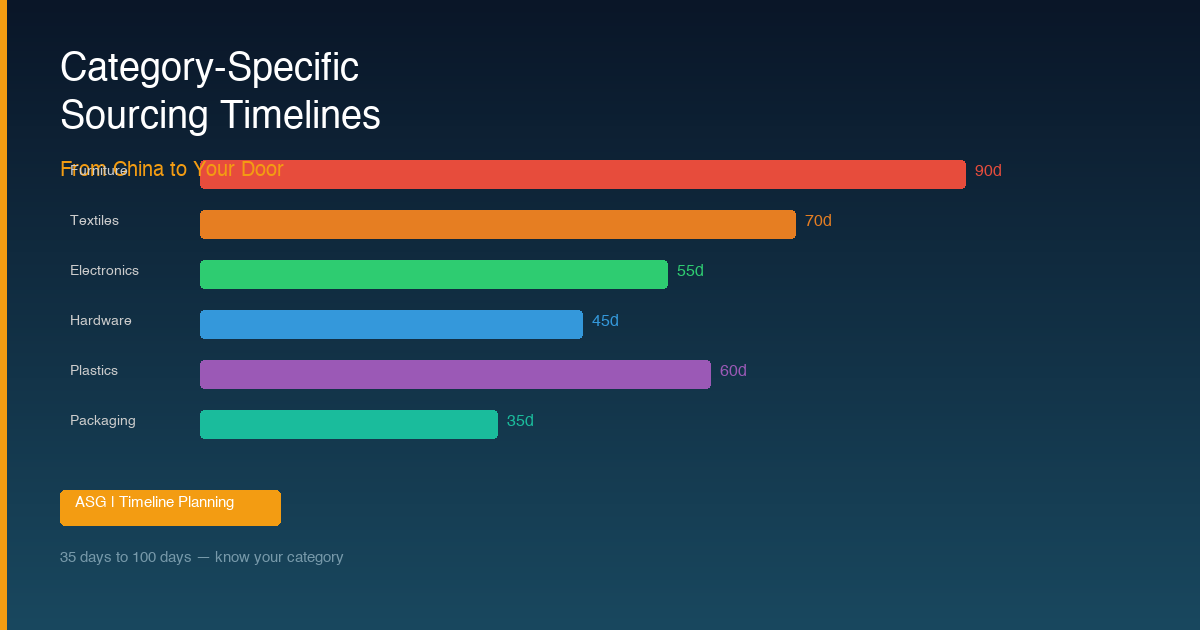
Category 1: Consumer Electronics & LED Products (45-75 Days Total)

| Phase | Duration | Key Bottleneck |
|---|---|---|
| Supplier Qualification | 2 weeks | Many suppliers available, the challenge is filtering, not finding |
| Sampling | 1-2 weeks | Standard products ship quickly; custom PCBs require additional time |
| Production | 20-30 days | Chip/PCB procurement can be the binding constraint |
| Inspection | 3-5 days | Functional testing requires specialized equipment |
| Logistics | 18-25 days | Standard sea freight |
Category-specific time traps:
- Chip shortages can suddenly extend lead times by 3-4 weeks, particularly during peak demand cycles. Always confirm component availability before committing to a delivery date.
- New certification testing (CE, FCC, UL) adds 2-6 weeks if not already held. Our guide on tariff-era compliance covers why certification documentation matters more than ever.
- Small orders get deprioritized, factories schedule small batches around their large-client production runs. Orders under 5,000 units may wait 1-2 extra weeks for a production slot.
Best ordering window: Q1 (January-March) or late Q4 (November-December) when factory capacity is underutilized. Avoid Q3 entirely, consumer electronics peak season creates 2-4 week scheduling delays.
Category 2: Furniture, Office, Home, Hotel (70-100 Days Total)

| Phase | Duration | Key Bottleneck |
|---|---|---|
| Supplier Qualification | 2-3 weeks | Requires physical sample assessment and craftsmanship evaluation |
| Sampling | 3-4 weeks | Custom furniture needs material sourcing, color matching, prototype construction |
| Production | 30-45 days | Wood drying, foam curing, fabric cutting; each has independent timelines |
| Inspection | 5-7 days | Visual inspection (scratches, color variance) + structural testing + packaging drop tests |
| Logistics | 20-28 days | Bulky items, container loading efficiency affects cost significantly |
Category-specific time traps:
- Material confirmation loops are the #1 time killer. Wood grain matching, fabric texture approval, foam density specification; each requires physical samples shipped internationally. Budget 3-4 rounds of material confirmation at 5-7 days per round.
- Peak season competition (March-May, September-November) can add 2-3 weeks of scheduling wait time as factories fill production slots with established clients.
- “One last revision” syndrome, furniture buyers frequently request final design changes after sampling, which triggers complete rescheduling of the production run.
Planning rule: Hotel and commercial furniture projects should begin sourcing 6-8 months before the required delivery date. The extra time investment in Phase 2 (thorough material and design confirmation) dramatically reduces Phase 4 rework, which is where furniture projects most commonly blow their timelines.
For understanding which manufacturing region offers the best furniture sourcing ecosystem, our regional sourcing guide explains why Foshan/Dongguan remains the default choice for mid-to-high-end furniture.
Category 3: Textiles & Apparel (50-80 Days Total)

| Phase | Duration | Key Bottleneck |
|---|---|---|
| Supplier Qualification | 2 weeks | Fabric mills and garment factories may be different suppliers |
| Sampling | 2-4 weeks | Lab dips (color matching) + garment sample construction |
| Production | 25-40 days | Fabric weaving/dyeing + cutting/sewing + finishing |
| Inspection | 3-5 days | Dimensional checks, color fastness, stitching quality |
| Logistics | 18-25 days | Standard sea freight |
Category-specific time traps:
- Lab dip cycles are chronically underestimated. Each color confirmation round takes 3-5 days. Complex or custom colors may require 3-4 rounds before approval, adding 2-3 weeks that buyers rarely budget for.
- Fabric weaving lead time is a separate process from garment production. If the factory doesn’t stock your fabric, weaving alone takes 15-20 days before cutting can even begin.
- Seasonal fabric production; some specialized fabrics (down-proof coatings, technical membranes) are only produced during specific seasons. Ordering outside those windows means waiting or accepting premium pricing from stock.
Seasonal ordering rules: Spring/Summer collections should be ordered by October-December of the previous year. Autumn/Winter collections should be ordered by March-May of the same year. Missing these windows typically adds 3-4 weeks.
Category 4: Hardware & Metal Fabrication (35-60 Days Total)

| Phase | Duration | Key Bottleneck |
|---|---|---|
| Supplier Qualification | 1-2 weeks | Suppliers concentrated in Yongkang/Dongguan, easy to find |
| Sampling | 1-3 weeks | Standard parts ship fast; custom parts require new tooling |
| Production | 15-25 days | Stamping, die-casting, CNC, surface treatment |
| Inspection | 2-3 days | Dimensional measurement + surface finish check |
| Logistics | 18-25 days | Heavy items, freight cost optimization matters more |
Category-specific time traps:
- New tooling/mold creation is the single long-lead item. A new stamping die or die-cast mold takes 15-25 days including design, machining, trial, and adjustment. Once tooling exists, repeat orders are fast.
- Surface treatment outsourcing, electroplating, powder coating, and anodizing are often subcontracted to specialized facilities, adding 5-7 days of coordination time.
- Raw material price volatility, steel and aluminum prices fluctuate weekly. Suppliers may hold quotes for only 7-10 days, compressing your decision window.
Planning insight: For existing-tooling products, lead times compress to 20-25 days. For new product development requiring new tooling, budget 60 days for the first order. Subsequent orders drop to the standard range.
Category 5: Plastic & Injection Molded Products (40-95 Days)
| Phase | Duration | Key Bottleneck |
|---|---|---|
| Supplier Qualification | 1-2 weeks | Ningbo (Huangyan) and Dongguan are primary clusters |
| Sampling | 3-5 weeks | Mold construction is the dominant phase |
| Production | 15-20 days | Injection cycles are fast; scheduling large batches takes time |
| Inspection | 2-3 days | Dimensional + visual + assembly fit testing |
| Logistics | 18-25 days | Standard sea freight |
Category-specific time traps:
- The mold is 80% of the time risk. Complex injection molds take 30-45 days to build, with 2-3 rounds of trial-and-adjustment. Once the mold is complete and validated, actual production runs in hours.
- Engineering plastics (PC, PA, POM) demand higher mold precision than commodity plastics (PP, PE, ABS), extending mold construction by 1-2 weeks.
- Multi-cavity molds produce more parts per cycle but may take longer to build. Compare the initial tooling lead time with the expected efficiency gains over repeat production runs.
Strategic advice: Invest in a high-quality mold from the start. A premium mold costs 20-30% more but delivers faster cycles, fewer defects, and 3-5x longer service life. Over a product’s lifetime, this is always the cheaper option.
Category 6: Packaging & Printed Materials (30-45 Days Total)
| Phase | Duration | Key Bottleneck |
|---|---|---|
| Supplier Qualification | 1 week | Dense supplier base (Dongguan, Wenzhou), fast response |
| Sampling | 1-2 weeks | Proofing + design confirmation |
| Production | 10-15 days | Printing, die-cutting, forming |
| Inspection | 1-2 days | Color accuracy, dimensions, material verification |
| Logistics | 18-25 days | Bulky but light, container efficiency optimization critical |
Category-specific time traps:
Keep Every Category on Schedule Without Chasing Suppliers
- Design revision loops: Each artwork change requires 2–3 days for revised proofs. Three rounds can add 1–2 weeks, especially when initial specifications are incomplete.
- Special processes: Hot stamping, UV coating, embossing, and flocking may require specialist subcontractors, adding 3–5 days.
- The “packaging last” mistake: Product factories often need packaging materials for final packing and container loading. Late packaging deliveries can leave finished goods in storage, increasing the risk of damage and occupying warehouse space.
Critical rule: Packaging should arrive at your product factory 2 weeks before production completion. Always order packaging first among all categories, even though it’s the fastest to produce.
The Hidden Time Killers That Apply Across All Categories
Chinese Public Holidays
These dates don’t appear on most Western calendars but dramatically impact your timeline:
- Chinese New Year (January/February): Factories shut down 2-4 weeks + 2-3 weeks ramp-up after return = 6-8 weeks real impact.
- National Day (October 1-7): 1-2 weeks including pre/post schedule adjustments.
- Qingming / Dragon Boat / Mid-Autumn: 2-3 days each individually, but when combined with weekends can create full-week disruptions.
The calculation: A “45-day production” order that spans Chinese New Year actually requires 75 calendar days. Always exclude Chinese holidays from your working-day calculations.
Peak Season Capacity Competition
| Peak Period | Affected Categories | Impact |
|---|---|---|
| March-May | Furniture, textiles, hardware (Western autumn orders) | 1-3 week scheduling delays |
| July-September | Electronics, packaging (Christmas/Black Friday stock) | 2-4 week scheduling delays |
| October-November | All categories (year-end rush) | 1-2 week delays across board |
Certification & Testing Delays
If your product requires new certifications (not previously held), add these timelines to your planning:
| Certification | Duration | Notes |
|---|---|---|
| CE (European Union) | 2-4 weeks | Varies by product type and test scope |
| FCC (United States) | 2-3 weeks | Required for all electronic products |
| UL (United States) | 4-8 weeks | One of the longest certification processes |
| REACH/RoHS | 2-3 weeks | Chemical compliance testing |
| BIFMA | 4-6 weeks | Office furniture testing standard |
| FDA Food Contact | 3-5 weeks | Materials contacting food/beverages |
The fix: Certification planning should begin during Phase 1 (supplier qualification), not after production is complete. Confirm existing certifications before selecting a supplier. Understanding how silent supplier signals can help you assess whether a supplier’s certification claims are genuine.
The Sample Approval Loop
One of the most common and preventable causes of sourcing delays is repeated sample revision.
Buyer receives sample → provides 3 comments → factory revises → buyer provides 2 more comments → factory revises again → 3-4 cycles complete → 4-6 extra weeks consumed.
How to compress this:
- Consolidate ALL feedback into one comprehensive review. Never send comments in batches.
- Distinguish “must fix” from “nice to have.” Non-critical items can be resolved during production rather than holding up sampling.
- Set a sample confirmation deadline: “After 3 revision rounds, we proceed with the latest version regardless.”.
The Multi-Category Sourcing Calendar
When sourcing multiple categories simultaneously, the biggest risk is asynchronous completion; some goods arrive early (incurring storage costs), others arrive late (delaying your entire project).
The “Backward Planning” Method
Start from your required delivery date and work backward for each category:
| Category | Working Days to Budget | Latest Order Date (for Dec 1 arrival) |
|---|---|---|
| Packaging & Printing | 40 days | October 22 |
| Hardware (existing tooling) | 50 days | October 12 |
| Electronics | 65 days | September 27 |
| Textiles | 70 days | September 22 |
| Plastics (existing mold) | 55 days | October 7 |
| Furniture | 90 days | September 2 |
The “Staggered Ordering” Strategy
Rather than ordering everything simultaneously, sequence your orders by category timeline:
- Order first (T-90 days): Furniture, longest lead time.
- Order second (T-75 days): Textiles and plastics with new molds.
- Order third (T-60 days): Electronics.
- Order last (T-45 days): Packaging and hardware with existing tooling.
Result: All categories complete production within the same 2-week window, enabling coordinated inspection and consolidated container loading, saving 15-25% on logistics costs.
Coordinating Packaging Delivery with Product Production
Among all categories, packaging materials should arrive earliest. Nearly every product factory requires packaging to complete final packing and container loading. The “order packaging after products are done” approach creates:
- Finished products sitting in factory warehouses (dust, moisture, damage risk).
- Production space occupation (factory can’t start new orders).
- Rushed packaging decisions under time pressure (quality suffers).
For more on calculating the true total cost including these timeline-related expenses, our true cost of sourcing guide provides the complete framework.
Seasonal Calendar: Best and Worst Months to Order
| Month | Electronics | Furniture | Textiles | Hardware | Plastics | Packaging |
|---|---|---|---|---|---|---|
| January | ⚠️ Pre-CNY rush | ⚠️ Pre-CNY rush | ✅ Off-peak | ✅ Off-peak | ✅ Off-peak | ✅ Off-peak |
| February | 🔴 CNY shutdown | 🔴 CNY shutdown | 🔴 CNY shutdown | 🔴 CNY shutdown | 🔴 CNY shutdown | 🔴 CNY shutdown |
| March | ✅ Recovery | ⚠️ Peak begins | ⚠️ Peak begins | ✅ Recovery | ✅ Recovery | ✅ Recovery |
| April-May | ✅ Ideal | 🔴 Peak | 🔴 Peak | ⚠️ Tight | ✅ Normal | ✅ Normal |
| June | ✅ Ideal | ✅ Peak ends | ✅ Normal | ✅ Normal | ✅ Normal | ✅ Normal |
| July-Aug | 🔴 Peak starts | ✅ Off-peak | ✅ Off-peak | ✅ Normal | ⚠️ Warming up | ⚠️ Holiday prep |
| September | 🔴 Peak | ⚠️ Peak resumes | ⚠️ Peak resumes | ⚠️ Tightening | 🔴 Peak | 🔴 Peak |
| October | 🔴 Peak + National Day | 🔴 Peak | 🔴 Peak | 🔴 Peak + holiday | 🔴 Peak | 🔴 Peak |
| November | ⚠️ Easing | ⚠️ Easing | ⚠️ Easing | ⚠️ Tight | ⚠️ Easing | ⚠️ Easing |
| December | ✅ Capacity opens | ✅ Capacity opens | ✅ Capacity opens | ✅ Capacity opens | ✅ Capacity opens | ✅ Capacity opens |
✅ Ideal (capacity available, faster scheduling) | ⚠️ Acceptable (capacity tight but workable) | 🔴 Avoid (capacity saturated, extended lead times, premium pricing)
Building Your Category-Specific Sourcing Timeline
- Step 1: Confirm the scope. Define product specifications, order quantities, destination, and required delivery date.
- Step 2: Validate supplier lead times. Confirm sampling, material procurement, production, inspection, and shipping schedules.
- Step 3: Identify dependencies. Map approvals and components that must be ready before production or final packing can proceed.
- Step 4: Add risk buffers. Account for confirmed holiday shutdowns, new tooling, testing, and capacity constraints.
- Step 5: Track milestones. Monitor material readiness, production progress, inspection results, and shipment arrangements.
These checkpoints are where our supplier management team provides independent, on-the-ground verification, catching problems before they become delays.
How ASG Manages Multi-Category, Multi-Timeline Projects
Coordinating multiple categories across different timelines and regions is a core ASG capability:
- Unified project management: One project manager overseeing all category timelines with integrated scheduling.
- Local execution across all regions: 25+ offices covering every major manufacturing cluster enables simultaneous progression across categories.
- Timeline visualization: Maintain a schedule for each category and a consolidated project plan to track dependencies, key milestones, and delivery dates.
- Proactive risk management: When one category signals delay, we automatically adjust downstream dependencies and propose mitigation strategies.
Typical multi-category projects we manage:
- Hotel fit-out projects (furniture + lighting + fixtures + signage + textiles).
- Retail rollouts (fixtures + displays + packaging + POS materials).
- Brand launches (products + packaging + marketing materials + accessories).
- Office relocations (furniture + electronics + supplies + branding).
After identifying opportunities at events like the Canton Fair, our Canton Fair follow-up guide explains how to convert fair contacts into production-ready supplier relationships within 30 days, multi-category timeline coordination becomes the next critical step.
Managing sourcing across multiple product categories? → Our project coordination ensures every category hits its timeline; and arrives together, ready for your launch date.
Frequently Asked Questions
What’s the single biggest cause of sourcing timeline delays from China?
Not production itself; it’s the “sample approval loop” and “raw material waiting time.” Many category delays stem from buyers providing feedback in multiple rounds rather than one comprehensive review, or from factories waiting for upstream materials to arrive. Actual production time typically accounts for only 30-40% of total elapsed time.
How far in advance should I place my first order from a new Chinese supplier?
Add 3-4 weeks of buffer beyond the standard category timeline for first-time relationships. New supplier engagements involve communication establishment, process alignment, and trust-building; all of which consume time that disappears in repeat orders. From the second order onward, expect 20-30% faster turnaround.
Is it realistic to expect faster lead times if I pay a premium?
Limited yes, in most categories. Rush orders typically mean the factory resequences production (putting your order ahead of others), which can compress timelines by 5-10 days at a 10-20% price premium. However, rush fees cannot compress raw material procurement, mold construction, or ocean transit time. The physics of production has a hard floor.
How do I handle a situation where one product category is delayed and others are ready?
Two strategies: (1) Ship completed goods first to avoid project delays, send remaining categories as supplementary shipments (higher logistics cost but project continues); (2) Wait for all categories to complete and ship together (optimal cost but project delayed). The right choice depends on your project deadline criticality and warehousing capacity. ASG offers a hybrid approach: partial shipment of critical items plus consolidated shipment of the remainder.
Does Chinese New Year really shut everything down for a month?
The real impact exceeds “one month.” Factories begin reducing output 1-2 weeks before the holiday (workers leave early), shut down completely for 2-3 weeks during the holiday, then require 2-3 weeks after return to reach full capacity (new employee training, equipment recommissioning). The total productivity impact is 6-8 weeks. Any order with production spanning January through March should include an automatic 4-week buffer in the timeline.