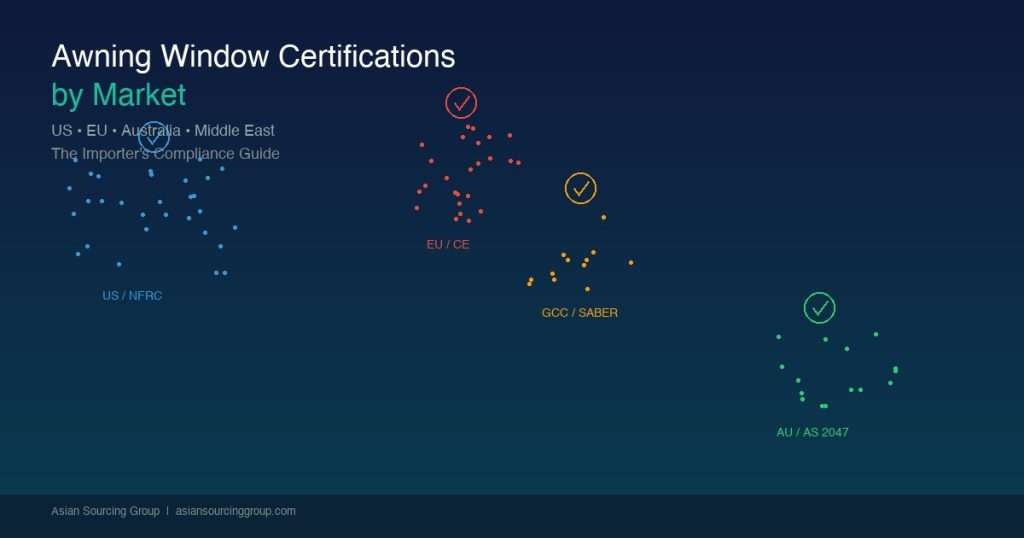
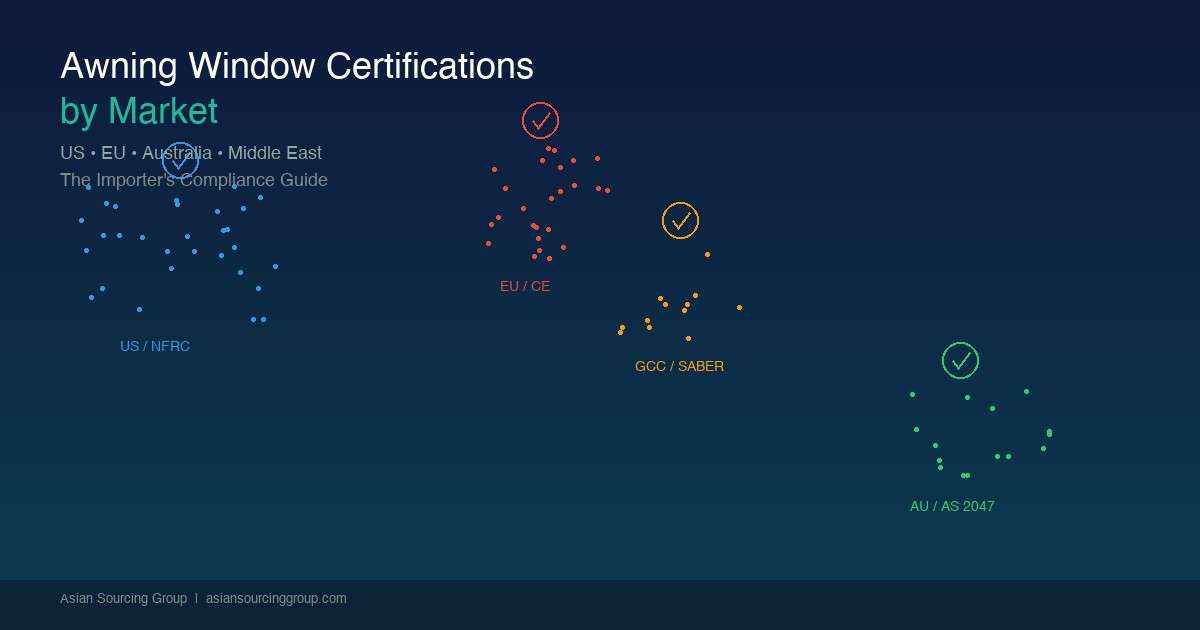
Window certification requirements differ by market. Missing documents can lead to shipment delays, extra testing, and unexpected costs. Even experienced Chinese manufacturers may lack the approvals required for a specific destination.
This article covers key awning window compliance requirements in the US, Евросоюз, Австралия, and GCC markets, including mandatory standards, supplier checks, and certificate verification.
Why Window Certifications Matter More Than You Think
Window certifications serve three functions simultaneously:
- Regulatory compliance, Without the right marks, your goods cannot clear customs or be legally installed in buildings subject to local building codes.
- Liability protection, If a window fails in service (thermal stress breakage, water infiltration, structural failure under wind load), the absence of proper certification transfers liability directly to the importer.
- Commercial credibility, Архитекторы, разработчики, and building surveyors specify certified products. Uncertified windows are automatically excluded from most commercial tenders and government projects.
The financial exposure is real. В Австралии, installing non-compliant windows in a Class 2-9 building can result in fines exceeding AUD $500,000 for the importer and the installer combined. В США, ENERGY STAR is a voluntary energy-efficiency program that relies on NFRC-certified ratings. Separate federal, состояние, местный, and project-specific requirements may also affect the documentation needed for a window installation.
Прежде чем заключать договор с каким-либо поставщиком, you need to understand the certification market of your target market. If you’re still evaluating suppliers, наш гид по молчаливые красные флажки при оценке поставщиков covers additional warning signs beyond missing certifications.
Соединенные Штаты: НФРК, ЭНЕРГИЯ СТАР, and Building Code Compliance
The Regulatory Framework
The United States has no single federal window certification mandate. Вместо, compliance flows through three overlapping layers:
- НФРК (National Fenestration Rating Council), Independent third-party rating system for thermal performance (U-factor, SHGC, VT, air leakage, condensation resistance). Not legally mandatory on its own, but referenced by most state and local building codes.
- ЭНЕРГИЯ СТАР, EPA-administered voluntary program that requires NFRC ratings plus additional performance thresholds. Many jurisdictions reference ENERGY STAR for code compliance or incentive programs.
- ICC/ANSI AAMA/WDMA/CSA 101/I.S.2/A440, The North American Fenestration Standard (NAFS) that defines structural performance grades (Р, ЛК, CW, AW) and water/air infiltration resistance. Required by the International Building Code (IBC) and International Residential Code (IRC).
What NFRC Certification Actually Requires
NFRC certification is a multi-step process:
- Product testing at an NFRC-accredited laboratory (thermal transmittance per ASTM C1199, solar heat gain per ASTM C1363, air leakage per ASTM E283).
- Simulation modeling using Lawrence Berkeley National Lab’s WINDOW and THERM software to validate test results.
- Factory inspection by an NFRC-recognized Independent Certification and Inspection Agency (ICIA).
- Product labeling with a permanent NFRC label showing U-factor, SHGC, and VT values.
- Annual renewal with periodic re-testing and unannounced factory audits.
Timeline from application to first label: обычно 12-20 недели. Расходы: US$8,000-$15,000 per product line (not per SKU), plus annual licensing fees of $2,000-$4,000.
ENERGY STAR Version 7.0 Требования (2024+)
ENERGY STAR Version 7.0 (effective October 2023) significantly tightened performance thresholds:
| Climate Zone | U-Factor (max) | SHGC (max) |
|---|---|---|
| Northern | 0.22 | 0.40 |
| North-Central | 0.25 | 0.40 |
| South-Central | 0.28 | 0.25 |
| Southern | 0.32 | 0.23 |
For awning windows specifically, the air leakage requirement is ≤ 0.3 cfm/ft² (operable units). Many Chinese factories achieve these values with triple-glazed IGUs and warm-edge spacers; but only if they’ve invested in the testing.
NAFS Structural Performance for Awning Windows
Under NAFS, awning windows fall under the «тент» operating type and must be rated for:
- Design Pressure (DP), typically DP 30-50 for residential, DP 50-70+ for commercial/high-rise.
- Water penetration resistance, tested at 15% of DP or minimum 2.86 psf.
- Air infiltration, tested at 1.57 psf positive and negative pressure.
- Structural load, tested at 1.5× DP without permanent deformation.
- Forced entry resistance, per ASTM F588 (optional but often specified).
What to Ask Your Chinese Factory
- «Do you have current NFRC product listings? Can I verify them on the NFRC Directory?» (NFRC Directory is publicly searchable).
- «Which ENERGY STAR climate zones do your ratings cover?».
- «Can you provide the NAFS test report showing DP rating and water penetration test results?».
- «Who is your ICIA? When was your last factory audit?».
Красный флаг: If the factory says «we can get NFRC certification for your order»; this means they don’t currently have it, and you’re being asked to fund and wait for the process. Фактор 4-6 months into your timeline. Learn more about managing category-specific sourcing timelines so certification delays don’t derail your project.
Евросоюз: CE Marking Under EN 14351-1 and the CPR
The Regulatory Framework
In the European Union, windows are regulated under the Construction Products Regulation (CPR) Нет. 305/2011. Since July 2013, all windows placed on the EU market must carry a CE mark backed by a Declaration of Performance (DoP).
The harmonized standard for windows is В 14351-1:2006+A2:2016 (Windows and doors, Product standard, performance characteristics, Part 1: Windows and external pedestrian doorsets).
What CE Marking Under EN 14351-1 Требует
Unlike NFRC (which focuses primarily on thermal performance), В 14351-1 is a comprehensive standard covering 15+ performance characteristics:
- Thermal transmittance (Uw), per EN ISO 10077-1/-2 or EN ISO 12567-1.
- Air permeability, per EN 1026, classified per EN 12207 (Classes 1-4).
- Watertightness, per EN 1027, classified per EN 12208 (Classes 1A-9A, E1200-E1500).
- Resistance to wind load, per EN 12211, classified per EN 12210 (Classes A1-C5, with deflection classes A/B/C).
- Acoustic performance (Rw), per EN ISO 10140-2, expressed per EN ISO 717-1.
- Dangerous substances, compliance with REACH and RoHS directives.
- Load-bearing capacity of safety devices, for restrictors and child safety limiters.
- Долговечность, repeated opening/closing cycles per EN 1191 (минимум 10,000 cycles for Class 2).
System 3 vs System 4: Notified Body Involvement
Under EN 14351-1, windows are assessed under AVCP System 3 или System 4:
| Характеристика | AVCP System | Notified Body Required? |
|---|---|---|
| Thermal transmittance | System 3 | Да, testing by Notified Testing Laboratory |
| Air permeability | System 3 | Да |
| Watertightness | System 3 | Да |
| Wind resistance | System 3 | Да |
| Acoustic performance | System 3 | Да |
| Долговечность, safety devices | System 4 | Нет, factory self-assessment acceptable |
System 3 characteristics require testing by a Notified Body (an EU-designated laboratory). Common Notified Bodies for window testing include ift Rosenheim (Германия), CSTB (Франция), and ITeC (Испания). Testing costs: €5,000-€12,000 per product family.
The Declaration of Performance (DoP)
The DoP is the document that must accompany every CE-marked window. It includes:
- Manufacturer’s name and address.
- Product type identification (модель, series).
- List of intended uses.
- Declared performance for each essential characteristic.
- Reference to the applicable harmonized standard.
- Notified Body number(с) involved in testing.
- Name of the authorized person signing on behalf of the manufacturer.
Critical point: The DoP must be issued by the производитель, meaning the Chinese factory. If you import under your own brand (частная марка), ты become the manufacturer under CPR and must issue the DoP yourself, taking full legal responsibility for the declared performance.
Post-Brexit UK: UKCA Marking
UK construction products: Great Britain continues to recognise CE marking for construction products that meet the applicable EU requirements, while UKCA marking remains another available route. Buyers should check the current designated standards, assessment requirements, and documentation applicable to the product and market. Northern Ireland follows different arrangements.
What to Ask Your Chinese Factory
- «Can you provide a current CE certificate from a recognized EU Notified Body?» (Check the NB number against the NANDO database).
- «Do you have a complete Declaration of Performance for the awning window series I’m importing?».
- «Has the test been performed on the exact configuration I’m ordering (frame material, glass type, opening mechanism)?».
- «For UK orders: do you have UKCA marking through a UK Approved Body?».
Красный флаг: Some factories present a «CE self-declaration» without Notified Body test reports for System 3 characteristics. This is non-compliant. The thermal, воздух, вода, and wind performance must be tested by a Notified Body, self-declaration only covers System 4 items.
Австралия: КАК 2047, the NCC, и $500,000 Комплаенс-риск

The Regulatory Framework
Australia has the most enforcement-heavy window compliance regime among major import markets. The chain works like this:
- National Construction Code (NCC), Deemed-to-Satisfy provisions reference AS 2047 for all external windows in Class 2-9 buildings (апартаменты, офисы, отели, школы, больницы).
- КАК 2047:2014 (Windows and external glazed doors in buildings), the product standard that defines design, строительство, installation, и требования к производительности.
- State building regulations; each state’s building surveyor enforces compliance and can issue building notices (stop-work orders) for non-compliant installations.
КАК 2047 Key Requirements for Awning Windows
КАК 2047 is particularly detailed on awning window design. Ключевые требования включают в себя:
- Wind load resistance, designed for site-specific wind pressures per AS/NZS 1170.2 (classified by Wind Zone: N1-N6, C1-C4 for cyclonic regions).
- Water penetration resistance, tested per AS 4284 (минимум 150 Pa for most applications, 300+ Pa for high-exposure or cyclonic areas).
- Air infiltration, maximum 3.0 L/s/m² at 75 Pa for conditioned spaces.
- Operating force, maximum 50 N to open, 30 N to close (critical for awning windows with friction stays).
- Долговечность, hardware must withstand 10,000 open/close cycles; friction stays must support sash weight × 1.5 safety factor.
- Safety glazing, per AS 1288, with specific requirements for «human impact» zones (low windows, двери, bath/shower areas).
The WERS Compliance Pathway
The Window Energy Rating Scheme (WERS) is Australia’s energy performance rating system for windows. While WERS itself is voluntary, the NCC’s energy efficiency provisions (Part J1.2/JV3) effectively require energy-rated windows for:
- All new Class 2-9 buildings.
- Renovations affecting more than 50% of the building envelope.
- Any project pursuing NatHERS star ratings (the standard marketing tool for Australian residential developments).
WERS ratings provide SHGC and U-value data verified by an accredited testing laboratory or simulation. For awning windows, achieving a low SHGC (≤ 0.25 for hot climates, ≤ 0.35 for mixed climates) often requires spectrally selective Low-E coatings, something Chinese manufacturers can achieve, but only if they’re producing to spec.
The Compliance Trap: Private Label Importers Become «Производители»
Under Australian Consumer Law and the NCC enforcement framework, if you import windows under your own brand name (or without any manufacturer identification), you assume the legal position of the manufacturer. This means:
- Ты must hold test reports proving AS 2047 согласие.
- Ты must be able to produce a Certificate of Conformity when requested by a building surveyor.
- Ты are liable for product recalls if non-compliance is discovered post-installation.
This is why our article on selecting the right awning window materials emphasizes compliance readiness as a key supplier selection criterion, not just material quality.
What to Ask Your Chinese Factory
- «Do you have AS 2047 test reports from a NATA-accredited laboratory?» (NATA = National Association of Testing Authorities, Australia’s accreditation body).
- «Can you provide wind load calculations specific to [your state’s wind zone]?».
- «Is your glass certified to AS 1288 for safety glazing applications?».
- «Do you have a current WERS rating for this product configuration?».
- «Can I have your test reports in my company name for the building surveyor?».
Средний Восток (GCC): SASO, ESMA, and the Evolving G-Mark regime


The Regulatory Framework
The Gulf Cooperation Council (Saudi Arabia, ОАЭ, Qatar, Kuwait, Bahrain, Oman) is implementing a unified product certification system, but individual countries still maintain their own enforcement mechanisms:
- Saudi Arabia, SASO (Saudi Standards, Metrology and Quality Organization) requires the SABER electronic conformity platform for all imported building products.
- ОАЭ: The Ministry of Industry and Advanced Technology (MoIAT) oversees the Emirates Conformity Assessment Scheme (ECAS).
- Qatar, Qatar Standards (QGOSM) requires pre-shipment inspection and CoC.
- G-Mark (Gulf Conformity Mark), the GCC-wide mark for regulated products, gradually replacing national marks for high-risk categories.
What This Means for Window Importers
Unlike the US, Евросоюз, и Австралия, where window performance standards are highly specific, the Middle East regulatory market is still evolving toward performance-based requirements. Current key requirements include:
- Тепловые характеристики; Most GCC countries reference U-value limits in their building energy codes. Saudi Arabia’s SBC 601 requires Uw ≤ 3.0 W/m²K for residential windows (significantly less stringent than EU/US/AU requirements). UAE’s Estidama/Dubai Green Building Regulations specify U ≤ 2.0 for villas and U ≤ 1.8 for commercial.
- Safety glazing, Tempered or laminated glass in hazardous locations per referenced standards (usually EN 12600 or ANSI Z97.1).
- Wind load, Per local structural codes, often referencing BS 6399 or ASCE 7 for high-rise buildings in Dubai/Abu Dhabi.
- Durability against sand/dust ingress, Unique to the region; air infiltration testing often at higher differential pressures to account for sandstorm conditions.
SABER Platform (Saudi Arabia), Step-by-Step
If you’re importing windows into Saudi Arabia, the SABER process works as follows:
- Product registration on the SABER platform (requires Saudi Commercial Registration or authorized representative).
- Conformity assessment by a SASO-approved Conformity Assessment Body (CAB), typically Bureau Veritas, СГС, ТЮВ, или Интертек.
- Shipment Certificate (SCoC), issued per shipment after SABER clearance.
- Product Certificate (PCoC), valid for 1 year, covers the product type.
Хронология: 2-4 weeks for initial PCoC if test reports are available; 8-12 weeks if new testing is required.
The Middle East Certification Advantage for Chinese Factories
Here’s a practical insight: Middle East thermal performance requirements are generally less demanding than US/EU/AU standards. A Chinese factory producing windows for the European market (Uw ≤ 1.6) already exceeds Saudi requirements (Uw ≤ 3.0) by a wide margin. This means:
Ship With Certifications That Actually Clear Customs
Asian Sourcing Group verifies NFRC, CE, КАК 2047, and SABER certificates against issuing-body databases so your windows clear compliance on arrival.- If your factory already holds EN 14351-1 протоколы испытаний, you can often leverage these for GCC market entry with minimal additional testing.
- The primary additional requirement is SABER/ECAS registration and shipment-level inspection.
- Focus your compliance budget on the registration process rather than re-testing.
This also explains why understanding the geography of Chinese manufacturing clusters matters, factories in Guangdong’s aluminum belt often produce for both European and Middle Eastern clients simultaneously, making dual-certification more common.
What to Ask Your Chinese Factory
- «Do you have SASO test reports or previous SABER certificates for Saudi Arabia?».
- «Can you provide ESMA/ECAS conformity documentation for UAE entry?».
- «Have you shipped windows to the GCC before? Can you share the CoC from a previous shipment?».
- «Which CAB (Бюро Веритас, СГС, ТЮВ) have you worked with for conformity assessment?».
The Certification Verification Checklist

Regardless of which market you’re importing into, follow this verification protocol before committing to a supplier:
Шаг 1: Request the Certificate Number
Every legitimate certification has a unique certificate or license number. If the factory cannot or will not provide one, they don’t have the certification.
Шаг 2: Verify on the Issuing Body’s Database
Сертификация Verification Source НФРК NFRC Certified Product Directory (nfr.org) ЭНЕРГИЯ СТАР ENERGY STAR Certified Products database (energystar.gov) CE / В 14351-1 NANDO database (ec.europa.eu/growth/tools-databases/nando) UKCA UK Market Conformity Assessment Bodies database (gov.uk) КАК 2047 / NATA NATA accredited organizations directory (nata.com.au) WERS WERS certified products directory (wers.net) SABER / SASO SABER platform (saber.sa), requires account access Шаг 3: Confirm Scope Covers Your Product
A factory may hold NFRC certification for their sliding window line but not for their awning window series. Certificates are typically issued per product family, verify that the specific operating type (тент), frame material, and glass configuration you’re ordering falls within the certified scope.
Шаг 4: Check Validity Dates
Certifications expire. NFRC licenses require annual renewal. CE certificates from Notified Bodies are typically valid for the duration of the factory’s FPC (Factory Production Control) system certification, usually 3-5 years with annual surveillance. Always check the expiry date and confirm the certificate hasn’t been suspended or withdrawn.
If you’re unsure how to validate supplier claims, наш гид по identifying red flags in supplier evaluation covers additional due diligence techniques.
Сравнение затрат: Certification Investment by Market
Рынок Сертификация Initial Cost (est.) Хронология Annual Renewal США НФРК + ЭНЕРГИЯ СТАР US$8,000-$15,000/line 12-20 недели $2,000-$4,000 США NAFS structural testing US$3,000-$6,000/test 4-8 недели Per project Евросоюз CE / В 14351-1 (Notified Body) €5,000-$12,000/family 8-16 недели FPC audit every 1-3 годы Великобритания UKCA (Approved Body) £4,000-$10,000/family 8-14 недели Similar to EU Австралия КАК 2047 (NATA lab) AUD $6,000-$15,000 6-12 недели Per project / annual Австралия WERS energy rating AUD $3,000-$6,000 4-8 недели Annual license Saudi Arabia SABER (PCoC) US$2,000-$5,000 2-4 недели Annual ОАЭ ECAS US$1,500-$4,000 2-4 недели Annual Strategic tip: If you plan to sell into multiple markets, find a factory that already holds certifications for your primary market. The incremental cost to add a secondary market certification is often 40-60% less than starting from scratch. This is where understanding realistic sourcing timelines helps you plan certification lead times into your project schedule.
Common Compliance Mistakes Importers Make
Ошибка 1: Предполагая «Export Quality» Means «Market Compliant»
Many Chinese factories market their products as «export quality» или «international standard» without specifying which market’s standards they meet. A window that passes Chinese national standard GB/T 8478 is not automatically compliant with NFRC, В 14351-1, or AS 2047. The test methods, performance thresholds, and labeling requirements differ significantly.
Ошибка 2: Accepting Test Reports from Non-Accredited Labs
NFRC requires testing at NFRC-accredited labs. В 14351-1 requires EU Notified Bodies. КАК 2047 requires NATA-accredited facilities. A test report from the factory’s in-house laboratory or an unaccredited third-party lab will not satisfy regulatory authorities in any of these markets.
Ошибка 3: Ignoring the Private Label Liability Transfer
If you import windows under your own brand, you become the legal manufacturer in most jurisdictions. This means YOU need the certificates, not just the factory. Plan accordingly; either maintain the factory’s brand on the product (with their certification), or budget for your own certification as the named manufacturer.
Ошибка 4: Treating Certification as a One-Time Event
Certifications require maintenance. Заводские аудиты, periodic re-testing, annual licensing fees, and product change notifications are all ongoing obligations. If your factory changes a glass supplier or hardware component, the certification may be voided until the new configuration is re-tested.
Ошибка 5: Underestimating Timeline Impact
Certification timelines frequently exceed initial estimates. Lab backlogs, sample shipping delays, documentation corrections, and audit scheduling can add weeks or months. Factor certification into your overall project timeline from day one, don’t treat it as an afterthought once production is complete.
How to Structure Your Supplier Agreement Around Certification
When finalizing terms with a Chinese window factory, include these certification-related clauses:
- Pre-shipment verification clause, «Seller shall provide valid, unexpired certificates for specific standards prior to first shipment. Failure to maintain certification constitutes a material breach.».
- Change notification requirement, «Seller shall notify Buyer in writing at least 30 days before any change to components, материалы, or manufacturing processes that may affect certified performance.».
- Testing cost allocation, Specify who pays for initial testing, re-testing after changes, and verification testing at destination.
- Liability allocation, If non-compliance is discovered post-import, who bears the cost of re-export, destruction, or retrofit? Define this explicitly.
- Right to verify, «Buyer reserves the right to commission independent verification testing at an accredited laboratory. Costs borne by Seller if product fails to meet declared performance.».
These clauses protect you from the scenario where a factory shows valid certificates during the sales process but ships product from a different (uncertified) production line, a problem that surfaces more often than you’d expect. For more on protecting yourself during supplier negotiations, review our coverage of warning signs your supplier may be failing.
Strategic Recommendation: Build a Certification Matrix
For importers selling into multiple markets, we recommend maintaining a living certification matrix:
Линия продуктов НАС (НФРК) Евросоюз (CE) Великобритания (UKCA) Австралия (КАК 2047) SA (SABER) ОАЭ (ECAS) Aluminum Awning 60 Series ✓ Exp: 2027 ✓ Exp: 2026 Никто ✓ Exp: 2027 ✓ Exp: 2027 ✓ Exp: 2027 Aluminum Awning 80 Series Никто ✓ Exp: 2026 Никто Никто Pending Никто uPVC Awning Standard ✓ Exp: 2027 Никто Никто ✓ Exp: 2028 ✓ Exp: 2027 Никто Update this matrix quarterly. Track expiry dates 90 days in advance. Never let a certification lapse, the cost of re-certification is typically 2-3× the annual renewal fee, and you cannot legally ship during the gap period.
Managing certifications across markets adds complexity to your sourcing operation. Learn how strategic sourcing planning can help you align compliance requirements with duty optimization and overall landed cost management.
Часто задаваемые вопросы
Can one factory hold certifications for multiple markets simultaneously?
Да. Larger Chinese window manufacturers (particularly those in Guangdong and Zhejiang clusters) often hold NFRC, CE/EN 14351-1, КАК 2047, and SABER certifications simultaneously. This is one reason why knowing which manufacturing regions produce for which export markets is strategically valuable.
How much does certification add to the per-unit cost of windows?
Amortized across a reasonable order volume (one 40HQ container minimum), certification costs typically add US$0.50-$2.00 per square meter for single-market certification, or $1.50-$4.00/m² for multi-market certification. This is marginal compared to the commercial risk of shipping uncertified product.
Is it cheaper to test locally (in destination country) or in China?
For initial certification, testing in China at an internationally accredited lab is usually 30-50% cheaper than testing in the US, Евросоюз, or Australia. Однако, some certification schemes (like NFRC) require testing at specific accredited facilities regardless of location. Factor in sample shipping costs and potential re-test expenses if the first attempt fails.
What happens if my shipment arrives without proper certification?
Worst case: customs seizure and mandatory re-export or destruction at your expense. Middle case: bonded storage while you arrange retroactive testing (8-12 недели, $200+/day in storage fees). Best case: conditional release with a compliance undertaking (you must demonstrate compliance within 30-90 days or face penalties).
Can I use a competitor’s test report if our products are identical?
Нет. Certifications are issued to specific legal entities (производители) for specific products. Even if your window is physically identical to a competitor’s certified product, you cannot use their test report. You need your own certification under your own name (or your factory’s name, if they are the named certificate holder and you are authorized as a distributor).
Следующие шаги: Making Certification Work for Your Business
Window certification is not a barrier; it’s a competitive moat. Importers who invest in compliance create defensible market positions that uncertified competitors cannot easily replicate. The factories that already hold multi-market certifications are your most valuable partners, because they’ve done the upfront work that prevents the costly surprises described at the beginning of this guide.
Whether you’re entering one market or planning multi-country distribution, the right sourcing partner can help you identify applicable requirements, verify supplier documents, and reduce the risk of costly compliance delays. Связаться с азиатской группой снабжения to discuss how we can help you identify and verify certified window suppliers across China’s major manufacturing regions, с 25+ offices covering all key production zones, we can coordinate factory audits, выборочное тестирование, and certification verification before you commit to any order.