Your supplier sent two quotes this morning. Aluminum awning windows: US$135/m². uPVC awning windows: US$85/m². The uPVC option looks 37% cheaper. You almost placed the order.
Three months later, the shipment arrives and you run the real numbers. Because uPVC ships fully assembled, you can’t knock it down for flat-packing, your container held barely half the square meters an aluminum knock-down shipment would carry. Your per-square-meter ocean freight for uPVC turned out to be more than double. After adding duty, insurance, destination handling, and the fact that two of the uPVC units arrived with cracked weld corners, the gap narrowed from 37% to about 8%.
This is the landed cost reality that FOB price sheets alone don’t reveal.
For windows, bulky, fragile, container-space-hungry products, the cost from factory gate to your warehouse is shaped by packing density almost as much as by material price. This article breaks down every cost component for aluminum versus uPVC window imports, with real container loading data and three worked scenarios for major destination markets.
For a broader material comparison including wood and fiberglass, our complete awning window materials guide covers all five options. This article goes deep on the two that dominate 80%+ of export orders.
Why FOB Price Lies, The “Assembled vs Knocked-Down” Problem

The Packing Density Gap
Aluminum window systems can typically ship knock-down (KD), frame profiles, glass panels, and hardware packed separately, to be assembled either at a destination factory or on-site. uPVC window frames are welded structures, corners are thermally fused, making the frame a single rigid unit that cannot be disassembled.
This creates a dramatic difference in container utilization:
| Metric | Aluminum (KD Shipment) | uPVC (Assembled Shipment) |
|---|---|---|
| 20GP loading capacity | 180-250 m² | 80-120 m² |
| 40HQ loading capacity | 350-500 m² | 150-220 m² |
| Indicative ocean freight per m² | $12-17/m² | $25-38/m² |
These figures are illustrative estimates; actual loading capacity and freight costs should be confirmed against the supplier’s packing plan and current carrier quotes.
uPVC’s FOB unit price is 25-40% lower. But its ocean freight per square meter is 100-150% higher. These two forces pull in opposite directions; and the net result is far closer than the FOB sheet suggests.
The “Air in the Container” Problem
When uPVC ships assembled, you are paying ocean freight for the air between installed glass panes and inside hollow frame chambers. Aluminum KD shipments pack profiles tightly alongside separately racked glass, space utilization improves by 2-3×.
Think of it this way: uPVC is like shipping a fully assembled wardrobe. Aluminum KD is like shipping flat-pack furniture, same product function, dramatically different shipping economics.
The Full Landed Cost Model, 7 Cost Components
Component 1: FOB Price (Factory Gate)
| Material | Standard Config FOB Range |
|---|---|
| Aluminum (non-thermal-break) | US$70-150/m² |
| Aluminum (thermal-break) | US$120-260/m² |
| uPVC (white, steel-reinforced) | US$55-120/m² |
At the factory gate, uPVC wins. Especially white standard configurations. This is where most buyers stop comparing; and where the error begins.
Component 2: Ocean Freight
Based on the packing density differences above, here’s a worked example for a 1,000 m² order:
| Material | Containers Needed | Total Freight | Per-m² Freight |
|---|---|---|---|
| Aluminum (KD, 40HQ) | 2-3 × 40HQ | $9,000-15,000 | $9-15/m² |
| uPVC (assembled, 40HQ) | 5-7 × 40HQ | $15,000-21,000 | $15-21/m² |
Depending on the selected freight estimates, the difference could reach $12,000 on a single order, enough to narrow the FOB gap significantly.
Component 3: Import Duty
Tariff treatment varies by destination and can affect the two materials differently:
- United States: Aluminum windows generally fall under HTS 7610.10, while uPVC windows generally fall under HTS 3925.20. Additional tariffs and trade remedies depend on the exact product classification and current rules for Chinese-origin goods. Aluminum extrusions may face anti-dumping or countervailing duties, so applicable measures should be checked for the specific product and exporter.
- European Union: Both materials carry standard MFN rates (~2.7-6.5% depending on exact classification). The EU’s CBAM (Carbon Border Adjustment Mechanism) will eventually affect aluminum more than uPVC due to aluminum’s higher embedded carbon.
- Australia: 5% general duty on both; no active anti-dumping cases specifically on finished windows from China (as of 2026), but aluminum extrusion imports do face scrutiny.
- Middle East (GCC): 5% common external tariff on both, minimal differential impact.
Component 4: Insurance and Handling
uPVC assembled windows are more vulnerable to transit damage, glass is already installed, welded corners are stress concentration points, and handling a fully assembled unit at every transfer point multiplies impact risk. Aluminum KD ships glass separately on A-frames and profiles bundled with protective interleaving, damage rates are measurably lower.
Insurance premium difference: typically 0.1-0.3% higher for uPVC assembled shipments (as a percentage of CIF value). On a $100,000 shipment, that’s $100-300, small in isolation, but it compounds with actual claim frequency.
Component 5: Destination Assembly Cost (Aluminum Only)
This is aluminum’s additional cost that uPVC avoids entirely. KD shipments require assembly at destination; and labor costs vary enormously by market:
| Destination Market | Assembly Cost Range |
|---|---|
| US / Canada | $15-35/m² |
| Australia / New Zealand | $20-40/m² |
| Western Europe | $18-35/m² |
| Middle East (UAE, Saudi) | $5-12/m² |
| Southeast Asia | $5-10/m² |
The critical question: do you have a reliable assembly partner at destination? If assembly quality is poor, you inherit warranty problems that offset any cost savings. Our supplier management service includes connecting clients with vetted assembly workshops in major destination markets.
Component 6: Warehousing and Inland Logistics
uPVC assembled windows go straight from port to job site; one movement, minimal storage. Aluminum KD requires: port → assembly facility → (assembly time: 3-10 days) → job site. This adds one handling cycle, 1-2 weeks of intermediate storage, and coordination complexity.
However, for phased projects where windows are needed in stages, KD aluminum offers flexibility, you assemble in batches as needed, reducing on-site storage congestion and damage risk at the construction site.
Component 7: Warranty and After-Sales Risk
This is the cost nobody quotes but everyone pays eventually:
- uPVC risk: Welded corners can develop micro-cracks during ocean transit (vibration + temperature cycling). These cracks are invisible at installation but manifest as air/water infiltration 12-24 months later. Remote warranty claims on Chinese uPVC windows are expensive to resolve, shipping replacement units internationally costs more than the units themselves.
- Aluminum risk: Mechanical corner joints (crimped or screwed with sealant) are inspectable and repairable on-site. If a corner leaks, it can be resealed locally. This makes aluminum’s after-sales exposure more predictable and more controllable.
A single batch quality failure (e.g., 50 units with cracked welds discovered post-installation) can erase the entire cost advantage of choosing uPVC on price alone.
Landed Cost Showdown, Three Real Scenarios

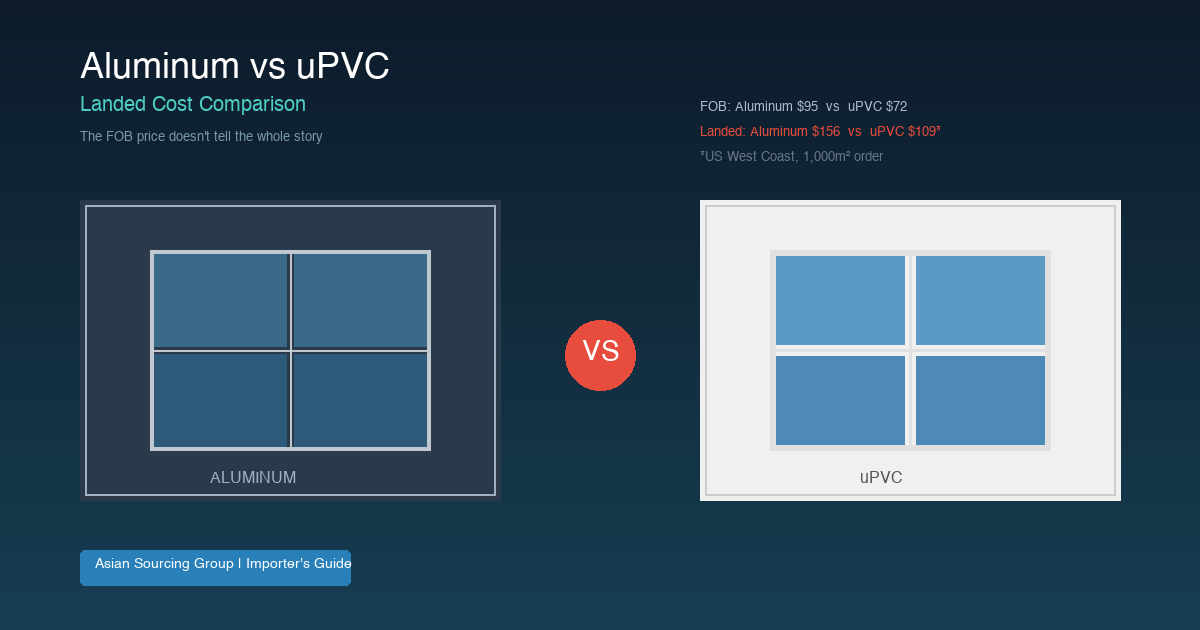
Scenario 1: 1,000 m² to US West Coast (Non-Thermal-Break, Standard Config)
| Cost Component | Aluminum | uPVC |
|---|---|---|
| FOB (mid-range config) | $95/m² | $72/m² |
| Ocean freight | $12/m² | $19/m² |
| Duty (incl. Section 301) | $14/m² | $11/m² |
| Insurance + port charges | $4/m² | $5/m² |
| Destination assembly | $25/m² | $0 |
| Warehousing + inland logistics | $6/m² | $2/m² |
| Landed total | $156/m² | $109/m² |
Get a Landed Cost You Can Actually Trust
Result: uPVC remains 30% cheaper on landed cost. The FOB gap of 24% widened to 30% because US assembly labor is expensive ($25/m²). In markets where you can assemble aluminum for less, or where thermal break is required (adding $40-80/m² to aluminum’s FOB), the equation shifts.
Scenario 2: 1,000 m² to Brisbane, Australia (Thermal-Break Aluminum vs uPVC)
| Cost Component | Aluminum (Thermal-Break) | uPVC |
|---|---|---|
| FOB (mid-range config) | $165/m² | $85/m² |
| Ocean freight | $11/m² | $18/m² |
| Duty (5%, no AD) | $8/m² | $4/m² |
| Insurance + port charges | $4/m² | $5/m² |
| Destination assembly | $30/m² | $0 |
| Warehousing + inland logistics | $7/m² | $2/m² |
| Landed total | $225/m² | $114/m² |
Result: Thermal-break aluminum costs nearly double uPVC on pure cost basis. However, Australia’s AS 2047 standard demands high weathering performance, particularly in Queensland’s tropical coastal zones where UV and salt exposure degrade uPVC surfaces faster. Over a 15-year project lifecycle, aluminum’s low-maintenance exterior can deliver lower total cost of ownership despite higher upfront cost.
Scenario 3: 1,000 m² to Dubai, UAE (Non-Thermal-Break, Hot Climate)
| Cost Component | Aluminum | uPVC |
|---|---|---|
| FOB (mid-range config) | $95/m² | $72/m² |
| Ocean freight | $10/m² | $16/m² |
| Duty (5% GCC) | $5/m² | $4/m² |
| Insurance + port charges | $3/m² | $4/m² |
| Destination assembly | $8/m² | $0 |
| Warehousing + inland logistics | $4/m² | $2/m² |
| Landed total | $125/m² | $98/m² |
Result: Gap narrows to 22%. Low UAE assembly costs let aluminum’s KD packing advantage show fully. Critically, dark-colored uPVC carries heat distortion risk in Gulf summer temperatures (surface temps exceeding 70°C), many Dubai specifications exclude uPVC for this reason, making aluminum the default regardless of cost.
Beyond Cost, 6 Non-Price Factors That Decide the Winner

Factor 1: Maximum Sash Size
uPVC is limited by frame rigidity and the weight of internal steel reinforcement. Above approximately 1.2m × 1.2m for top-hung awning sashes, the friction stays struggle to support the weight over time. Aluminum handles significantly larger sashes, increasingly important as modern architectural designs favor larger window openings.
If your project specifies awning windows above 1.5m wide, aluminum is likely your only viable option.
Factor 2: Color and Finish Flexibility
Aluminum accepts powder coating in any RAL color, woodgrain heat-transfer sublimation, and anodizing. uPVC in white is stable and affordable; colored uPVC requires foil lamination (adding cost and UV vulnerability) or co-extrusion (limited palette). Dark colors in uPVC absorb heat, causing profile expansion, a particular concern in tropical and desert climates.
Factor 3: Thermal Performance per Dollar
uPVC’s multi-chambered profile is inherently insulating, achieving U-values of 1.4-2.0 W/m²K with standard double glazing, without any thermal break. Aluminum requires a polyamide thermal break insert to achieve similar performance, adding 40-70% to the profile cost.
In cold-climate markets (Canada, Scandinavia, northern US), uPVC delivers more thermal performance per dollar spent. This is why uPVC dominates the North American replacement window market.
Factor 4: Recyclability and Green Building Credits
Aluminum is infinitely recyclable without quality loss, a significant advantage in LEED-certified projects and markets with carbon-conscious building codes. uPVC is technically recyclable but has low actual recycling rates and faces environmental scrutiny in several European markets.
If your project targets LEED, BREEAM, or similar certification, aluminum earns materials credits that uPVC cannot.
Factor 5: Lead Time and Supply Resilience
Aluminum profile extrusion is fast (7-15 days) and the supplier base is vast, Guangdong alone has hundreds of extrusion lines. uPVC profile extrusion is also quick, but specific cross-sections may only be available from a handful of factories with proprietary molds.
For urgent orders or fast replenishment, aluminum’s deeper supplier pool provides more scheduling flexibility. Understanding realistic sourcing timelines by product category helps you plan accurately for either material.
Factor 6: End-Customer Perception and Resale Value
In Australia, New Zealand, and parts of North America, aluminum windows command a price premium in the resale market; they are perceived as “the proper material.” uPVC in these markets is sometimes associated with “cheap rentals” or temporary buildings, regardless of actual quality.
In the UK, Ireland, and much of Northern Europe, uPVC is the mainstream choice with no negative connotation. Your end market’s perception directly affects your pricing power and margin.
The Decision Framework, When to Choose Which
Choose uPVC When:
- Budget is the primary constraint and sash sizes are standard (below 1.2m × 1.2m).
- Destination is a temperate or cold-climate market (UK, Northern Europe, North American replacement).
- End market has no negative perception of uPVC.
- White frames satisfy the design brief.
- You have no destination assembly capability.
Choose Aluminum When:
- Project requires large sash sizes or non-standard dimensions.
- Destination is hot-climate, high-UV, or coastal.
- Specific colors or premium finishes are required.
- Project targets green building certification.
- You have (or can establish) reliable destination assembly.
- End market commands a price premium for aluminum.
The Hybrid Approach
Many successful import projects use both materials strategically: uPVC for standard bedroom and bathroom windows (cost optimization), aluminum for lobby areas, commercial spaces, and feature windows (performance and visual impact). Asian Sourcing Group coordinates dual-material projects from a single sourcing platform, unified quality standards, consolidated inspections, and synchronized shipping.
How to Model Your Own Landed Cost Comparison
Step 1: Get Aligned FOB Quotes
Request quotes from 2-3 aluminum and 2-3 uPVC suppliers with identical specifications, same glass type, same hardware grade, same performance class. “Standard configuration” varies enormously between factories. Align specs first, compare prices second.
Step 2: Calculate Real Packing Density
Ask each supplier for a detailed container loading plan showing exactly how many square meters fit per 40HQ. This single number reshapes the entire comparison.
Step 3: Add Freight + Duty + Insurance
Use current freight rates (they fluctuate, use quotes no older than 3 months). Confirm exact HTS codes and applicable duty rates for your destination. Include any active anti-dumping or countervailing duties.
Step 4: Factor Destination Costs
For aluminum KD: get local assembly quotes at your destination. For uPVC: calculate direct-to-site delivery from port. Include 1-2 weeks’ storage buffer for either option.
Step 5: Compare on Equal Terms
Sum all costs, divide by total area → per-m² landed cost. This is your decision number, not the FOB sheet. Our true cost of sourcing framework provides the complete methodology for any product category.
How Asian Sourcing Group Helps You Make the Right Call
We don’t make one-size-fits-all recommendations. The optimal material depends on your destination, climate, budget, project scale, and end-market positioning. Our window sourcing service includes:
- Full landed cost modeling; we build the comparison using your actual project parameters, not generic assumptions.
- Dual-material supplier networks, qualified aluminum and uPVC factories in Guangdong, Shandong, and Zhejiang.
- Unified quality standards, same inspection criteria regardless of material, so you’re comparing like-for-like.
- Packing optimization, especially for aluminum KD shipments where packing design directly affects freight cost per m².
- Destination assembly referrals, vetted assembly partners in major markets (US, Australia, EU, Middle East).
Before committing to a material choice, review the 7 red flags that indicate supplier quality issues, material choice matters less if the factory making it is unreliable.
Send us your project specs → We’ll return a complete aluminum vs uPVC landed cost comparison for your specific project within 48 hours, including freight, duty, assembly, and risk assessment.
Frequently Asked Questions
Is uPVC always cheaper than aluminum for window imports?
On FOB price, uPVC is typically 25-40% cheaper. But once you add ocean freight (uPVC packs 50% fewer m² per container), insurance (higher damage rates on assembled units), and destination costs, the gap narrows to 10-30%. For large sash sizes in hot climates, aluminum can actually cost less over the project lifecycle due to lower warranty exposure.
Can uPVC windows handle hot climates like the Middle East or Australia?
White uPVC performs adequately in hot climates. Dark-colored uPVC, however, carries genuine heat distortion risk, surface temperatures exceeding 65-70°C on dark profiles in full Gulf or Australian sun can cause profile bowing over time. Most Dubai and northern Australia specifications exclude dark uPVC for this reason. If your project requires non-white frames in a hot market, aluminum is the safer choice.
What’s the biggest hidden cost of importing uPVC windows?
Container space waste. Because uPVC ships assembled, you pay ocean freight on the empty volume inside each window unit and between stacked frames. A 40HQ container holds 150-220 m² of assembled uPVC windows versus 350-500 m² of aluminum KD components. On a 1,000 m² order, that means 3-4 extra containers, $9,000-12,000 in additional freight.
Do I need a local assembly partner for aluminum KD shipments?
Yes. Aluminum knock-down shipments require frame assembly, glazing, and sealing at destination. If you don’t have an existing assembly workshop, Asian Sourcing Group can connect you with vetted assembly partners in major destination markets. The alternative is having the Chinese factory assemble before shipping; but this eliminates the KD freight advantage entirely.
How do I get an accurate landed cost comparison for my specific project?
Contact Asian Sourcing Group with your project area, window dimensions, destination country, and performance requirements. Within 48 hours, we deliver a side-by-side landed cost comparison covering FOB, freight, duty, assembly, insurance, and risk-adjusted warranty costs for both aluminum and uPVC options suited to your market.