
Deciding between private label and custom manufacturing is a strategic pivot point for any product developer or brand owner. This choice determines whether your primary focus remains on rapid market entry or deep-tier engineering and intellectual property control.
This guide provides a direct comparison of both production models, evaluating capital efficiency, technical scalability, and long-term supply chain flexibility. We examine the operational trade-offs between leveraging pre-existing formulations and investing in bespoke fabrication, helping you align your manufacturing strategy with your specific growth trajectory and technical requirements.
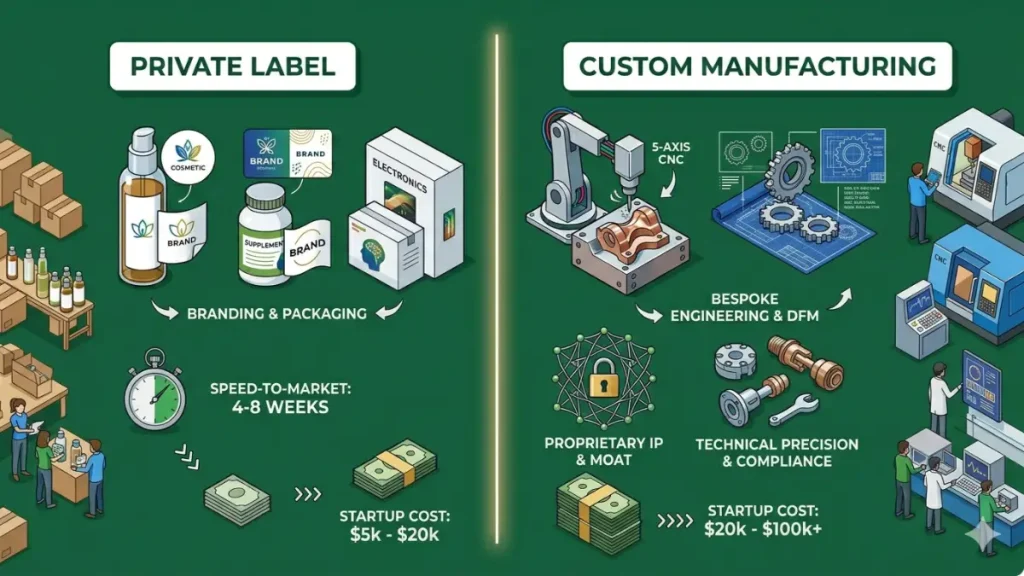
What Is Private Label Manufacturing?
Private label manufacturing is a production model where a third-party manufacturer creates goods based on a brand’s specific requirements for exclusive sale under that brand’s name. Unlike white-label alternatives, private label products allow for unique formulations, specialized packaging, and proprietary designs without the overhead of factory ownership.
This model differentiates itself through exclusivity and customization. While the manufacturer handles physical production and quality standards, the brand owner maintains full authority over:
- Product Identity: Unique ingredients and proprietary formulas.
- Quality Control: Direct oversight of material standards and finishing.
- Market Positioning: Control over pricing, branding, and distribution.
By leveraging a manufacturer’s existing infrastructure, brands can adapt to market trends rapidly. This setup avoids the massive capital requirements of specialized equipment or factory facilities. The brand focuses on marketing and logistics, while the producer executes technical assembly, ensuring a balance between speed-to-market and brand equity development.
What Is Fully Custom Manufacturing?
Fully custom manufacturing is the process of building a product from the ground up based on unique engineering specifications. Unlike private labeling, this model requires bespoke tooling and advanced fabrication to meet precise tolerances for mission-critical applications.
The foundation of custom production is Design for Manufacturability (DFM). This phase utilizes CAD/CAM modeling and Finite Element Analysis (FEA) to ensure complex geometries are functional and optimized for repeatable production. Key operational advantages include:
- Vertical Integration: Handling CNC machining, plating, and assembly under one roof to reduce lead times.
- Prototyping to Scale: Seamless transitions from initial 100-unit runs to high-volume production.
Custom manufacturing excels in holding extreme tolerances, such as ±0.001 inches via 5-axis CNC machining. It is essential for projects requiring specialized material performance with superalloys like Inconel 718, Titanium, or 316L Stainless Steel. These processes ensure full compliance with rigorous international standards, including ISO 13485 for medical devices and AS9100 for aerospace.
Cost Differences Between the Two Models
The primary financial distinction between these models lies in the development phase.
Private label manufacturing leverages existing product lines, which effectively eliminates the burden of R&D and formula development. Conversely, custom manufacturing requires a substantial initial investment in unique formulations, proprietary tooling, and specialized raw material sourcing.
| Expense Category | Private Label | Custom Manufacturing |
|---|---|---|
| Upfront Investment | Minimal; focused on branding and design. | High; includes R&D and custom tooling. |
| MOQ Requirements | Low (e.g., a few hundred units or cases). | High; requires large batches for setup. |
| Development Costs | Zero; utilizes pre-existing formulations. | Substantial; covers unique specifications. |
| Time to Market | Fast; immediate production availability. | Slow; requires long prototyping phases. |
Initial Capital and Development
The primary financial distinction between these models lies in how production infrastructure is funded. In private label manufacturing, the factory has already amortized the costs of R&D, formulas, and equipment. This allows you to preserve your capital for marketing and distribution rather than tying it up in factory-level assets.
Conversely, custom manufacturing requires you to fund the exclusivity. Beyond the visible costs of proprietary tooling and unique raw materials, you must account for the intensive engineering oversight and quality control necessary to bring a completely new product to market. While the initial outlay is significantly higher, this investment builds the technical barriers and brand protection required for a premium market position.
MOQs and Unit Pricing
Scalability and production volume requirements differ sharply:
Low-Barrier Entry: MOQ in China for private label products is typically low—often starting at a few hundred units. This allows brands to manage cash flow while testing market-fit.
Economies of Scale: Custom manufacturing requires larger batch sizes to offset specialized mechanical setups. However, at high volumes, this model often yields more competitive unit pricing and a higher long-term ROI by securing total brand ownership and eliminating third-party formulation fees.
Scale Your Brand with a Trusted China Sourcing Partner

Timeline Tradeoffs
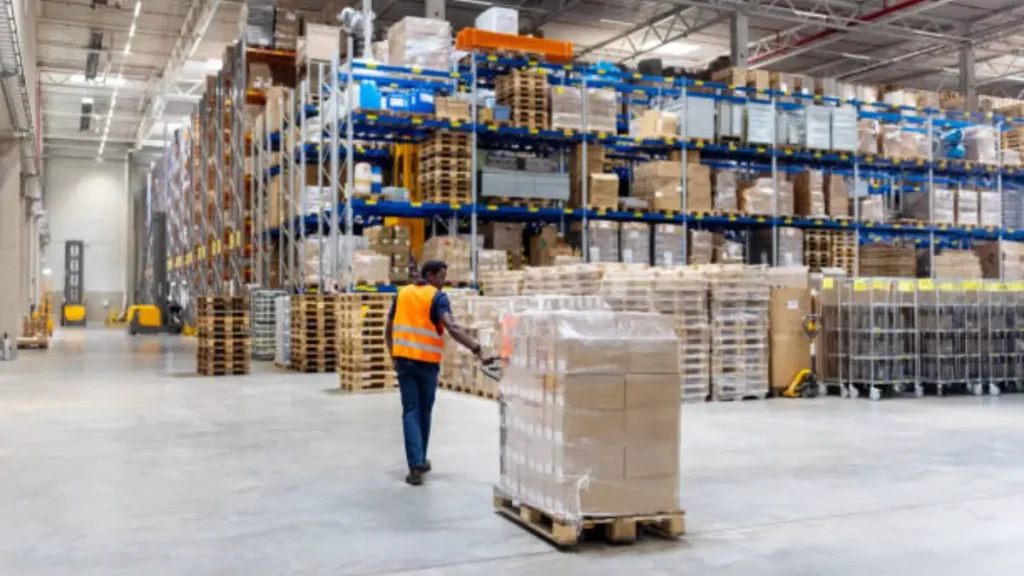
The primary difference in the China product sourcing timeline between these two models is the R&D requirement. While custom manufacturing builds from zero, private label leverages existing validation.
Private Label: Rapid Market Entry
Private label offers a streamlined launch window of 4–8 weeks. This speed is achieved by bypassing the exhaustive R&D phase and utilizing formulations that have already undergone stability testing.
- Key Advantage: Immediate production availability.
- MOQ Advantage: Typically 500–1,000 units, facilitating faster inventory turnover.
- Ideal For: Brands prioritizing speed and low capital risk for initial market validation.
Custom Manufacturing: The Engineering Lifecycle
Custom development requires an intensive engineering period, generally spanning 3–12 months. This extended timeline is necessary to establish proprietary IP and meet specific performance standards.
- Development Phases: Includes bespoke prototyping, proprietary mold fabrication, and rigorous packaging validation.
- Compliance Standards: Governed by mandatory protocols such as FDA-registered systems or CGMP-certified facilities.
- MOQ Requirement: Usually 3,000–5,000 units per SKU to sustain production efficiency for unique runs.
Navigating these complex milestones often requires a professional sourcing agent to manage supplier verification and production deadlines. An experienced agent ensures that lead times remain predictable, preventing production delays.
Branding & IP Considerations

Securing legal ownership of trademarks, logos, and formulations is critical to preventing counterfeiting and ensuring long-term brand equity. While private label allows for faster entry, custom manufacturing offers deeper control over proprietary intellectual property (IP).
Protecting Intellectual Property (IP)
Establishing definitive ownership prevents unauthorized duplication. The level of protection varies by model:
- Private Label: Focuses on securing trademarks for brand names and unique packaging. Since the base formulation may be shared, exclusivity is built through visual identity and proprietary design tweaks.
- Custom Manufacturing: Focuses on full IP control. This includes patenting unique formulations, mechanical designs, and bespoke production techniques. It creates a technical barrier that prevents competitors from replicating the exact product.
Strategic Supplier Partnerships
Protecting your brand goes beyond paperwork—it requires vetting. Long-term partnerships with reputable manufacturers are necessary to safeguard trade secrets. By auditing suppliers for ethical history and transparency, brand owners can mitigate the risk of “back-door” production or IP leakage to competitors.
Regulatory Compliance & Standards
Navigating international trade requires adherence to market-specific standards to ensure legal entry into the US, EU, and Australia.
- Certification Requirements: Essential frameworks include CE, FDA, RoHS, and REACH.
- Quality Assurance: Manufacturers must be verified for ISO standards and industry-recognized certifications.
- Trust & Transparency: Rigorous labeling and supply chain tracing build consumer trust, particularly in highly regulated sectors like health, beauty, and food production.
Scalability and Flexibility Comparison
Private label manufacturing offers high flexibility for market testing. By using pre-existing, stability-tested formulations, brands can achieve a launch window of 4–8 weeks. This model significantly lowers financial risk through MOQs as low as 50–100 units.
This agile framework supports rapid experimentation. Brands can adjust order volumes dynamically to respond to market demand. Because the formulas are already validated, there is no need for complex production reconfigurations or technical stability adjustments during initial growth.
In contrast, fully custom manufacturing provides superior long-term scalability. It integrates proprietary products into established CGMP and FDA-registered systems. While it requires a 3–6 month development cycle, this infrastructure-centric approach ensures high-volume production efficiency and end-to-end oversight.
By leveraging professional batch records and specialized quality teams, manufacturers can scale proprietary IP while minimizing recall risks. This model builds a robust foundation for established brands that require unique technical specifications and high-yield, repeatable production at scale.
When Each Model Makes Sense
Choosing between these two models depends on your brand’s maturity and the specific competitive advantage you intend to build.
Choosing Private Label for Brand-Led Growth
Private label is the logical choice if your advantage lies in marketing, storytelling, or community engagement. It is ideal for entering established categories where existing, market-ready formulations already meet consumer expectations.
By bypassing the R&D phase, you can capitalize on seasonal trends or execute rapid market testing. This model preserves your capital for customer acquisition, making it a low-risk entry point for startups focused on digital marketing execution rather than technical engineering.
Opting for Custom Manufacturing for Technical Moats
Custom manufacturing is necessary if your strategy depends on proprietary innovation or unique specifications. This approach is non-negotiable for highly regulated industries, such as medical devices, where design ownership and strict quality standards are required.
While it demands a larger commitment, it provides the exclusivity needed to defend a premium market position. By controlling every aspect from raw materials to final assembly, you prevent competitors from replicating your product, effectively securing your long-term innovation.
Decision Matrix: Which Path Should You Take?
| Feature | Private Label | Custom Manufacturing |
|---|---|---|
| Startup Costs | $5,000 – $20,000 | $20,000 – $100,000+ |
| Lead Time | 4 – 8 Weeks | 12 – 24 Weeks |
| Minimum Order (MOQ) | Starting at 500 units | 1,000 – 5,000 units |
| Innovation Level | Market-ready / Standard | Proprietary / Unique |
Final Thoughts
Selecting between private label and custom manufacturing depends on your maturity and technical requirements. Private label offers capital-efficient market testing with minimal risk, while custom manufacturing secures the intellectual property and exclusivity needed for long-term differentiation.
Navigating the complexities of Chinese manufacturing requires an expert on-the-ground partner. ASG acts as your dedicated procurement lead, specializing in supplier verification, strict quality control, and logistics management for both private label and custom projects. We bridge the gap between your technical specifications and factory-direct execution, ensuring your supply chain remains transparent and scalable.
Frequently Asked Questions
Which manufacturing model is faster to market?
Private label is significantly faster, typically offering lead times of 4–8 weeks. In contrast, fully custom manufacturing requires 12–24 weeks to account for product development, prototyping, and tooling.
Which option offers better long-term profit margins?
While private label has lower entry costs ($5,000–$20,000), custom manufacturing offers higher long-term margins through lower per-unit costs and market exclusivity, despite higher upfront investments of $20,000–$100,000.
What are the risks of using a private label approach?
The primary risks include market saturation due to generic product appearances, limited control over quality and production, and higher per-unit pricing that can eat into profits as your order volume scales.
When should a brand choose fully custom manufacturing?
Custom manufacturing is ideal for brands targeting premium or niche markets that require unique formulations, proprietary designs, or specific intellectual property (IP) protection once market demand has been validated.
Can I start with private label and switch to custom manufacturing later?
Yes. Many brands use private label to test demand with low MOQs (500–1,000 units). Once the product is proven, they transition to fully custom manufacturing, which typically requires higher MOQs of 1,000–5,000 units.



-300x198.png)


