You just walked out of the Canton Fair with twenty window catalogs in your bag. Every factory rep told you their bestseller is “the one you should be importing.” Some swore awning windows are the global trend. Others insisted casement dominates everywhere that matters. You can’t launch both simultaneously, not with your budget, not with your first container order. You need a clear answer on which window type to bet on.
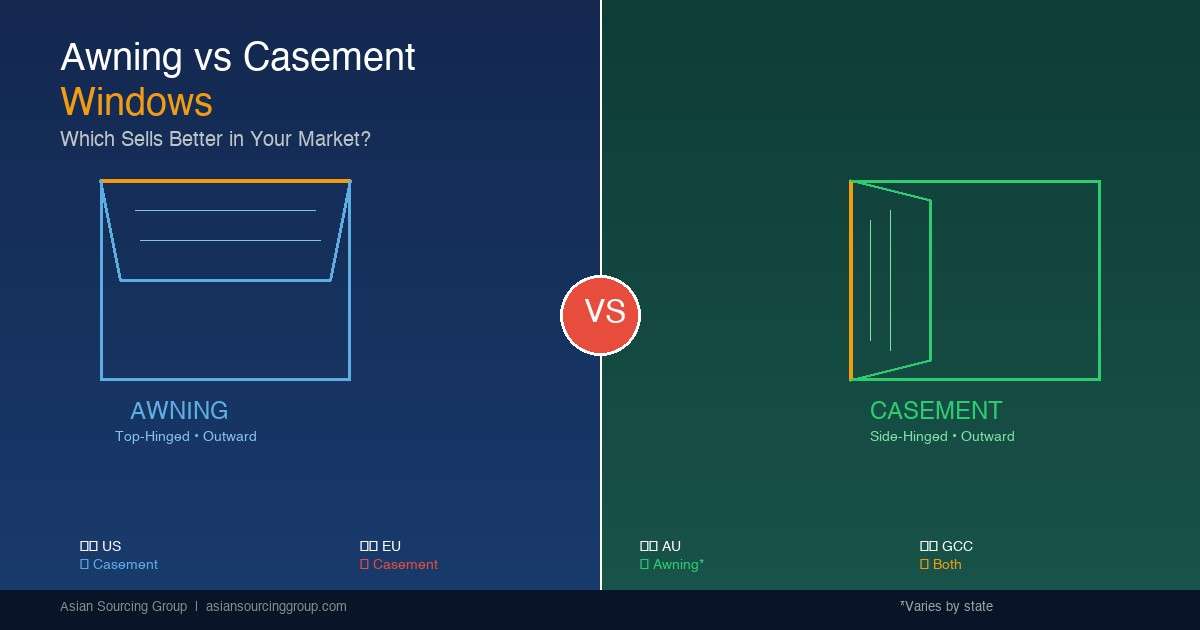
Here’s what none of those factory reps told you: the answer depends entirely on which market you’re selling into. In the United States, double-hung and single-hung windows lead residential volume, with casement windows a strong second in operable units. In Queensland, Avustralya, awning windows outsell casement in residential construction. In the Middle East, both move volume; but for completely different project types.
This guide breaks down the technical differences, market-by-market demand patterns, logistics economics, and certification requirements for awning versus casement windows. By the end, you’ll have a five-question framework to decide which product line deserves your first order.
The Physical Difference and Why Your Buyers Care
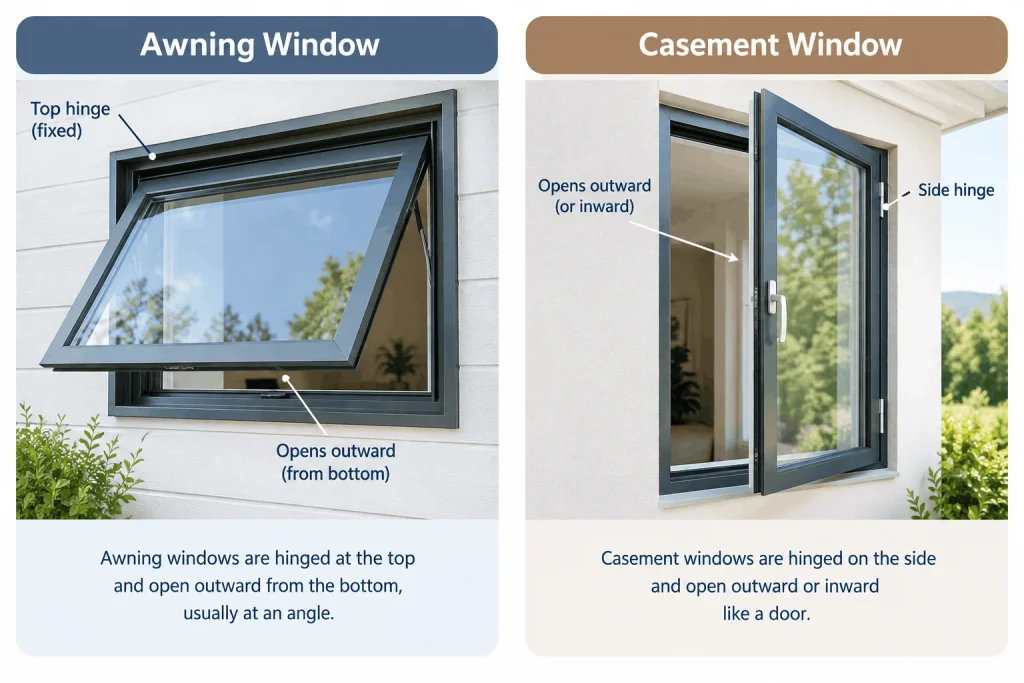
Before comparing markets and margins, let’s establish the mechanical distinction clearly:
- Awning window: Hinged at the top, opens outward and upward, like a small roof or canopy extending from the wall. Operated by a crank handle or push-out mechanism with friction stays holding the sash in position.
- Casement window: Hinged at the side, opens outward like a door. Operated by a crank handle connected to a multi-point locking system that pulls the sash tight against the frame seals.
These mechanical differences create distinct performance profiles that matter to end users:
| Performance Factor | Awning Window | Casement Window |
|---|---|---|
| Rain ventilation | Harika, open position sheds rain | Fakir, rain enters when open |
| Maximum ventilation area | ~60-70% of opening | ~90-100% of opening |
| High-position installation | Ideal (above doors, in bathrooms) | Impractical (needs arm reach) |
| Wind pressure resistance | İyi (limited by friction stay strength) | Harika (multi-point compression seal) |
| Air infiltration rate | Ilıman (friction seal) | Düşük (compression seal, tipik olarak 0.1-0.2 cfm/ft²) |
| Egress compliance | Olası (with specific sizing) | Easier (full opening width) |
İthalatçılar için, these physical differences translate directly into which project types each window serves; and therefore which markets order them in volume. If you’re still mapping out where Chinese window manufacturing clusters are located, understanding end-use scenarios helps you match factory specialization to your target demand.
Market-by-Market Demand Analysis: Where Each Type Dominates
This is the section that most comparison articles skip. Every buyer’s guide tells you casement provides better ventilation or that awning windows work in bathrooms. Almost none tell you which type moves more units in your specific destination market.
Amerika Birleşik Devletleri & Kanada: Casement Leads, Awning Fills Niches
North America is a casement-dominant market. Buna göre AMAMA (American Architectural Manufacturers Association) industry data, double-hung and single-hung windows dominate new residential construction, while casement windows hold a minority share of the operable market.
The dominance stems from three factors:
- ENERGY STAR air leakage requirements, Sürüm 7.0 requires ≤ 0.3 cfm/ft² for operable units. Casement’s compression-seal multi-point locking system consistently achieves 0.1-0.2 cfm/ft². Awning windows can meet this threshold but require higher-quality friction stays and tighter tolerances.
- Building code egress requirements, IRC Section R310 mandates emergency escape openings in bedrooms. Casement windows meet egress sizing more easily because the full opening width is usable.
- Consumer preference, North American homeowners associate casement windows with modern design and unobstructed views. Awning windows are perceived as commercial or utilitarian.
Where awning wins in North America: commercial buildings (school corridors, hospital bathrooms, office ventilation), below-grade basement windows (hopper-style awnings), and as transom units above fixed panels in high-end residential.
Importer strategy: Casement windows are a suitable starting point for North American residential projects, while awning models can serve commercial buildings and basement applications. Both require NFRC certification and NAFS structural testing, factor 12-20 weeks into your sourcing timeline.
Avrupa Birliği & İngiltere: Casement Dominates, Awning Is Niche
The European window market is fundamentally different from North America. The dominant operable window type across continental Europe is the tilt-and-turn (Dreh-Kipp-Fenster), which combines side-hinged opening with top-tilt ventilation in a single unit. Traditional side-hung casement (opening outward) remains popular primarily in the UK and Ireland.
Awning windows as a standalone category barely exist in the European market. The reasons are structural:
- İÇİNDE 14351-1 testing protocols have extensive historical data for casement and tilt-and-turn configurations, Notified Bodies charge premiums for less common types due to additional engineering assessment.
- European building design favors large, floor-to-ceiling operable units, awning windows are too small for this application.
- The tilt function of tilt-and-turn windows provides the same rain-safe ventilation benefit that awning windows offer, eliminating the functional advantage.
Importer strategy: If you’re targeting EU markets, casement or tilt-and-turn are your only realistic primary products. Awning windows serve no volume role. Fakat, if you already manufacture awning windows for other markets, UK casement (outward-opening, side-hung) shares enough mechanical similarity that retooling is minimal. The CE marking requirements under EN 14351-1 apply identically to both types.
Avustralya & Yeni Zelanda: Awning’s Stronghold
Australia is where the script flips. In tropical and subtropical regions (Queensland, Northern Territory, northern New South Wales), awning windows are the dominant operable window type in residential construction. The reasons are climate-driven:
- Frequent rain + need for ventilation, Tropical Australia experiences afternoon thunderstorms 100+ days per year. Awning windows allow continuous ventilation even during downpours. Casement windows must be closed every time it rains.
- Cyclonic wind zones, GİBİ 2047 classifies wind regions up to C4 (cyclonic, 69 m/s ultimate limit state). Tente pencereleri, when closed, present a lower-profile wind load surface. Their friction-stay mechanism also avoids the “sail effect” risk of a side-hinged casement catching a gust during operation.
- Combination with fixed panels, Australian residential design favors large fixed-glass panels with awning ventilators above or below. Bu “picture window + ventilation strip” configuration is standard in Queensland project homes.
In southern Australia (Melbourne, Adelaide, Tasmania), the climate is temperate and casement windows maintain market share comparable to North American patterns.
Importer strategy: Segment by state. Queensland/Northern Territory projects → lead with awning. Victoria/South Australia/New Zealand → lead with casement. Both require AS 2047 testing through a NATA-accredited laboratory, but awning windows have well-established test protocols under the standard.
Orta Doğu & Güneydoğu Asya: Dual Demand, Different Drivers
The GCC region (Suudi Arabistan, BAE, Katar, Kuveyt) presents a unique demand pattern:
- Tente pencereleri dominate in commercial, misafirperverlik, and institutional buildings, hotels use small awning ventilators in bathrooms and service areas. Schools and hospitals specify awning windows for corridor ventilation with child-safety restrictions.
- Casement windows serve residential villas and mid-rise apartments where occupant-controlled ventilation is expected.
In Southeast Asia (Tayland, Vietnam, Filipinler, Endonezya), casement windows are the traditional residential standard. Awning windows appear primarily in commercial towers and institutional buildings. The growing hospitality sector creates steady awning demand for hotel bathroom and corridor applications.
Importer strategy: For Middle East entry, both types can ship in the same container, different project types absorb both. For Southeast Asia, start with casement (higher volume, established supply chain from Guangdong) and add awning when commercial project inquiries justify it.
Lojistik & İthalat Maliyeti: The Hidden Economics
Beyond FOB price, the logistics of shipping windows internationally create meaningful cost differences between the two types:
Container Utilization
| Faktör | Tente Pencereleri | Kanatlı Pencereler |
|---|---|---|
| Typical shipping configuration | Fully assembled (simple structure) | Knock-down (KD) or assembled |
| Units per 40HQ (standard size) | 1,000-1,500 birimler | 800-1,200 birimler (KD) / 600-900 (assembled) |
| Freight cost per unit (est. @ $4,000/40HQ) | $2.70-$4.00 | $3.30-$5.00 (KD) / $4.40-$6.70 (assembled) |
| Packaging complexity | Düşük (fewer moving parts) | Ilıman (hardware protection required) |
| Damage rate in transit | 1-2% | 3-5% (hinge/lock damage risk) |
The per-unit freight advantage favors awning windows by approximately $0.60-$1.70 birim başına. Across a 1,200-unit order, that’s $720-$2,040 in freight savings alone. For a detailed breakdown of how material choice compounds this effect, bizimkine bakın aluminum vs uPVC landed cost comparison.
FOB Price Ranges (Aluminum Frame, Double-Glazed, Standard Specification)
| Şartname | Awning (per m²) | Casement (per m²) |
|---|---|---|
| Basic (single-point lock, standard glass) | US$80-$100 | US$95-$120 |
| Orta seviye (friction stay, Low-E glass) | US$100-$130 | US$120-$145 |
| prim (multi-point lock, triple-glazed) | US$130-$160 | US$145-$180 |
Awning windows are typically 10-20% cheaper at FOB level due to simpler hardware (friction stay vs. multi-point locking system) and smaller average frame profiles. When you combine the lower FOB price with better container utilization, the FOB cost advantage for awning windows is typically 15-25%, a significant margin difference for price-sensitive markets.
Inventory Complexity
Awning windows tend toward standardized sizing because:
Choose the Right Window Type for Your Market
- Friction stays have practical width limits (typically max 1,200mm for standard hardware).
- Larger awning sashes become too heavy for manual operation.
- The market has converged on 4-6 standard sizes that cover 80% of applications.
Casement windows span a much wider size range (from 400mm bathroom units to 1,200mm living room panels), requiring more SKUs in inventory. For a first-time importer building initial stock, awning windows require lower capital commitment per SKU.
Installation Scenarios: Matching Window Type to Project

Understanding which projects specify which window type helps you target the right buyer segments:
| Başvuru | Primary Window Type | Neden |
|---|---|---|
| High-rise apartment bathroom | Awning | High-wall mounting, privacy, continuous ventilation |
| Residential bedroom/living room | Casement | Maximum ventilation, unobstructed view, egress |
| Commercial office building | Awning | Standardized sizing, curtain wall integration, restricted opening for safety |
| School/hospital corridor | Awning | Child-safe limited opening, rain ventilation, az bakım |
| Luxury villa sunroom | Casement | French-style opening, maximum airflow, design aesthetic |
| Basement egress window | Hopper (bottom-hinged) | Meets IRC R310 sizing, below-grade water resistance |
| Tropical balcony/veranda | Awning | Rain protection, shade extension, continuous ventilation |
| Hotel guest room bathroom | Awning | Privacy at height, humidity control, restricted opening angle |
This table becomes a powerful sales tool when you’re pitching to developers or building contractors. Showing that you understand Neden their project needs a specific window type positions you as a solutions partner rather than a commodity supplier. For more on building supplier credibility during evaluation, review our guide on identifying red flags during supplier evaluation.
Donanım & After-Sales: The Long-Term Cost Reality
Window hardware determines not just the product’s performance but your post-sale support burden. Importers who ignore this factor end up spending more on warranty claims than they saved on FOB price.
Casement Hardware Complexity
A typical casement window includes:
- Side hinges (2-4 birim başına, load-bearing).
- Multi-point locking system (3-5 locking points with cam rollers).
- Operator mechanism (crank handle + worm gear + arm).
- Stay arm (holds window open at various angles).
- Compression seals (perimeter, 4+ contact points).
Common failure modes: hinge sagging under sash weight (especially in large units), lock cam misalignment after thermal cycling, operator gear stripping under excessive force. Estimated warranty claim rate: 2-4% of installed units over 5 yıllar.
Awning Hardware Simplicity
A typical awning window includes:
- Friction stay hinges (2 birim başına, integrated stay mechanism).
- Single-point or two-point latch.
- Operator (crank + push rod, or manual push-out with stay).
- Optional: electric actuator for automated ventilation.
Common failure modes: friction stay wear causing the sash to drift closed (or open in wind), electric actuator motor failure (motorized versions only). Estimated warranty claim rate: 1-2% of installed units over 5 yıllar.
The after-sales implication: Casement windows require a more comprehensive spare parts inventory (menteşeler, lock cams, operator arms, seals in multiple lengths). Awning windows need primarily friction stay replacements, a single component that covers most service scenarios. If your after-sales infrastructure is limited (remote market, no local warehouse), awning windows generate less support burden.
Certification Difficulty: Is One Easier Than the Other?
Both window types face identical certification frameworks in each market; but the practical difficulty varies:
| Pazar / Standart | Casement | Awning |
|---|---|---|
| NFRC (BİZ) | Extensive reference data available; straightforward | Less historical data; may require additional simulation iterations |
| ENERJİ YILDIZI (BİZ) | Same performance thresholds apply | Same thresholds, harder to achieve air leakage target with friction seal |
| İÇİNDE 14351-1 (AB) | Well-established; standard test configurations | “Non-standard type” at some Notified Bodies; +15-25% test cost |
| GİBİ 2047 (Avustralya) | Standard test protocol | Dedicated friction stay test clause; actually provides clearer compliance path |
| KILIÇ (Orta Doğu) | No differentiation | No differentiation |
The practical takeaway: in Europe, certifying casement is cheaper and faster. Avustralya'da, awning actually benefits from dedicated test clauses. In North America, casement has a slight edge due to accumulated reference data. In the Middle East, it doesn’t matter.
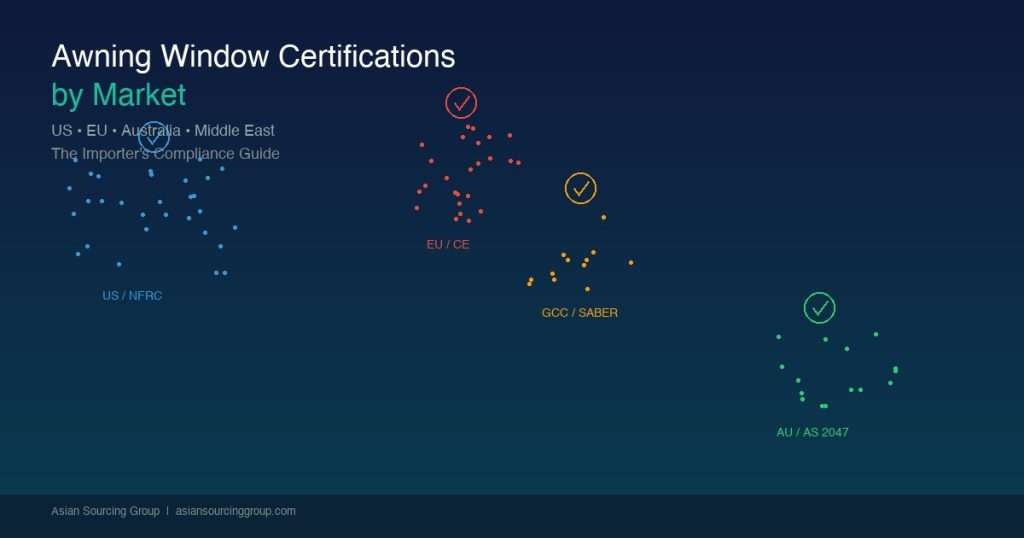
For a complete breakdown of certification timelines and costs by market, see our certification guide by market.
The Decision Framework: Five Questions to Choose Your Primary Type
If you’ve read this far, you have enough information to make your decision. Work through these five questions in order:
1. Where Is Your Target Market?
- Kuzey Amerika / İngiltere / Continental Europe → Start with casement.
- Avustralya (QLD/NT) / Southeast Asia commercial → Start with awning.
- Avustralya (VIC/SA) / Yeni Zelanda → Start with casement.
- Orta Doğu / Afrika → Both work; choose based on question 2.
2. Who Is Your Primary Customer Type?
- Residential developers → Casement is the primary ask in most markets.
- Commercial contractors / institutional projects → Awning volumes are larger.
- Retail distributors / hardware stores → Casement turns faster; awning fills gaps.
- Hospitality / healthcare sector → Awning dominates bathroom and corridor specs.
3. What’s Your Budget and First Order Volume?
- Limited budget, first import experience → Start with awning (fewer SKUs, simpler hardware, lower landed cost per unit, easier to sell through).
- Moderate budget, established distribution → Lead with casement for your market’s dominant type, add the other within 6 aylar.
- Strong budget, aggressive market entry → Launch both simultaneously; negotiate combined volume pricing with your factory.
4. What Does Your Factory Already Excel At?
This question is more important than most buyers realize. Chinese window factories typically develop deep expertise in one primary window type and produce others as secondary products. A factory whose production line is 80% casement will deliver better quality, daha hızlı teslimat süreleri, and lower defect rates on casement orders than on awning orders; and vice versa.
Ask your factory: “What percentage of your monthly output is casement vs. tente?” If the answer shows a strong imbalance, align your order with their strength rather than pushing them to make what they’re less experienced with. For more on evaluating factory capabilities, see our coverage of Tedarikçinizin başarısız olabileceği uyarı işaretleri to meet your requirements.
5. How Will You Handle After-Sales?
- Local team with spare parts warehouse → Casement is manageable; stock hinges, lock cams, and operators.
- Remote support, ship replacement parts internationally → Awning is lower-risk; one friction stay type covers 80% of service needs.
- No formal after-sales (project-based selling) → Either works; focus on quality control at shipment instead.
Can You Do Both? The Multi-Product Strategy
The ideal end-state for most importers is a dual-product catalog, awning and casement covering the full range of project specifications. The question is timing.
Recommended phasing:
- Faz 1 (Ay 1-6): Launch with your market’s dominant type. Secure 2-3 repeat customers. Learn the logistics, sertifikasyon, and after-sales workflow with one product family.
- Faz 2 (Ay 6-12): Add the second type based on actual customer inquiries (“Do you also supply awning windows?” is a buying signal). Leverage the same factory relationship, freight forwarder, and certification knowledge.
- Faz 3 (Yıl 2+): Build bundled product packages, “tente + casement standard pack” for distributors, project-specific mix packages for developers.
This phased approach reduces your initial risk while building toward full product line coverage. Understanding realistic category-specific sourcing timelines helps you plan when to trigger each phase without over-committing capital.
Sıkça Sorulan Sorular
Which window type provides better energy efficiency?
Both types can achieve the highest energy ratings available in any certification system. The difference lies in consistency: casement’s compression seal delivers slightly better air infiltration performance (0.1-0.2 cfm/ft² vs. 0.2-0.3 cfm/ft² for awning). pratikte, glass configuration (Low-E coating type, gas fill, spacer type) matters more for overall U-value than the operating type.
Is one type cheaper to manufacture in China?
Awning windows are typically 10-20% cheaper at FOB due to simpler hardware (friction stay vs. multi-point lock) and smaller average frame profiles. Fakat, when you factor in container utilization, navlun, and duty, the landed cost advantage narrows to 8-15%. The material choice (aluminum vs. uPVC) often has a larger impact on total cost than the window type itself.
Can the same factory produce both types?
Most aluminum window factories in China can produce both awning and casement windows on the same production line (different hardware kits, same profile system). uPVC factories tend to specialize more, the welding and assembly equipment is often optimized for one primary type. If you’re sourcing uPVC, you may need two factories for full coverage.
Which is easier to install on-site?
Awning windows are generally easier to install: lighter weight, simpler frame geometry, and no side-hinge alignment requirement. For large-scale projects where installation labor is a significant cost component, this advantage translates to real savings, tipik olarak 15-25% faster installation time per unit compared to casement.
What about tilt-and-turn windows?
Tilt-and-turn combines aspects of both (side-opening like casement + top-tilting like awning) in a single unit. It dominates the European market but is rarely exported from China due to complex hardware requirements (European-designed mechanisms from Siegenia, Roto, or GU). If your market demands tilt-and-turn, sourcing from Chinese factories is possible but requires verifying their experience with European hardware systems.
Making Your Decision Count
The awning vs. casement decision isn’t about which product is objectively better; it’s about which product fits your specific market, customer base, operational capacity, and growth timeline. The importers who succeed aren’t the ones who pick the “Sağ” window type in the abstract. They’re the ones who pick the right window type for their particular situation and execute well on sourcing, sertifikasyon, ve satış sonrası destek.
Whether you’re starting with awning windows for the Australian market or casement for North America, having a sourcing partner who understands both product types and can help you expand your catalog when the time is right, makes the difference between a single-product trader and a full-line window supplier.
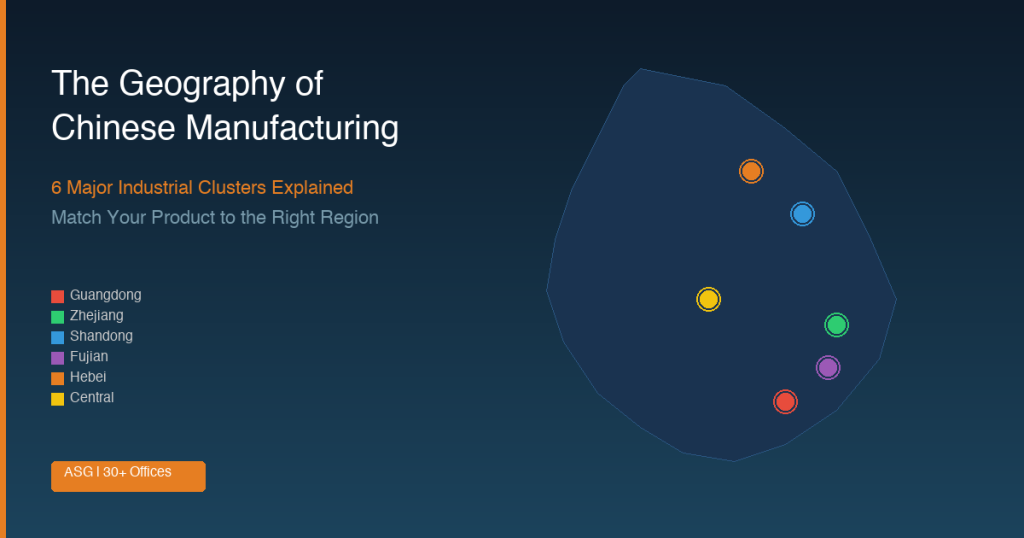
Asian Sourcing Group ile iletişime geçin to discuss your window sourcing strategy. With offices across Guangdong, Zhejiang, and Shandong, China’s three major window manufacturing regions; we can help you identify factories that specialize in your target product type, coordinate certification testing, and manage quality control from first sample to container loading. Whether you’re placing your first trial order or scaling to monthly shipments, our team ensures your window import operation runs smoothly from factory floor to destination port.