You search “office chair” on Alibaba and get 500 fornecedores. Some quote $25, others quote $55. All claim to be “professional manufacturers.” What’s the difference?
The answer isn’t about which factory is better; it’s about which manufacturing region they’re located in. Na China, the same product from Foshan versus Yiwu versus Hebei represents completely different price logic, quality positioning, Flexibilidade de pedido, and delivery reliability.
China’s manufacturing isn’t spread evenly across the country. It’s organized into highly specialized industrial clusteré; and understanding this geography is one of the most underrated skills in China sourcing. A buyer who knows which region specializes in their product category can cut through 80% of the noise on any sourcing platform.
This article is your region-by-region field guide to Chinese manufacturing clusters. After reading it, you’ll know exactly where your product “belongs”; and why that matters more than any individual supplier’s sales pitch.
Why Region Matters More Than You Think

China’s manufacturing sector is defined by industrial clustering. Entire cities, sometimes entire counties, specialize in specific product categories. This clustering creates ecosystems where raw materials, fornecedores de componentes, mão de obra qualificada, instalações de teste, and logistics infrastructure all exist within a tight geographic radius.
When you understand this clustering, a supplier’s location tells you a surprising amount before you’ve even asked a single question:
| What Region Tells You | Por que é importante |
|---|---|
| Faixa de preço | Same category, different regions can differ 30-50% in FOB price |
| Quality positioning | Some regions specialize in high-end export; others in budget bulk |
| Flexibilidade de pedido | Mature clusters accept smaller orders (500 peças); newer ones require larger commitments |
| Delivery stability | Complete local supply chains = fewer material shortages = more reliable timelines |
| Communication maturity | Export-oriented regions have better English and international service experience |
| Certification readiness | Regions that primarily export have CE/FCC/REACH documentation as standard practice |
The mistake most buyers make is treating “China” as a single sourcing destination. Na realidade, it’s more like sourcing from a continent with dramatically different economic zones; and your product-region match determines your cost, qualidade, e perfil de risco.
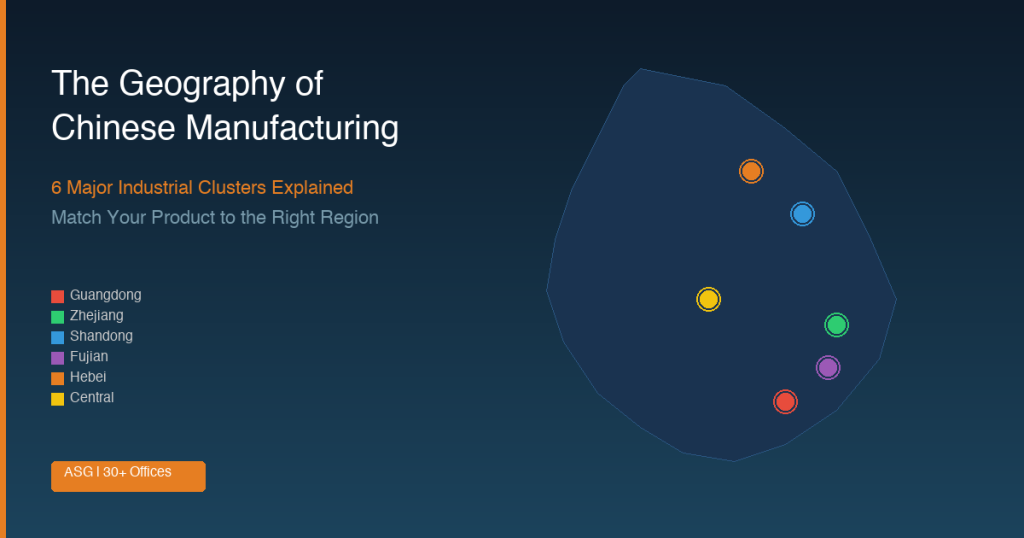
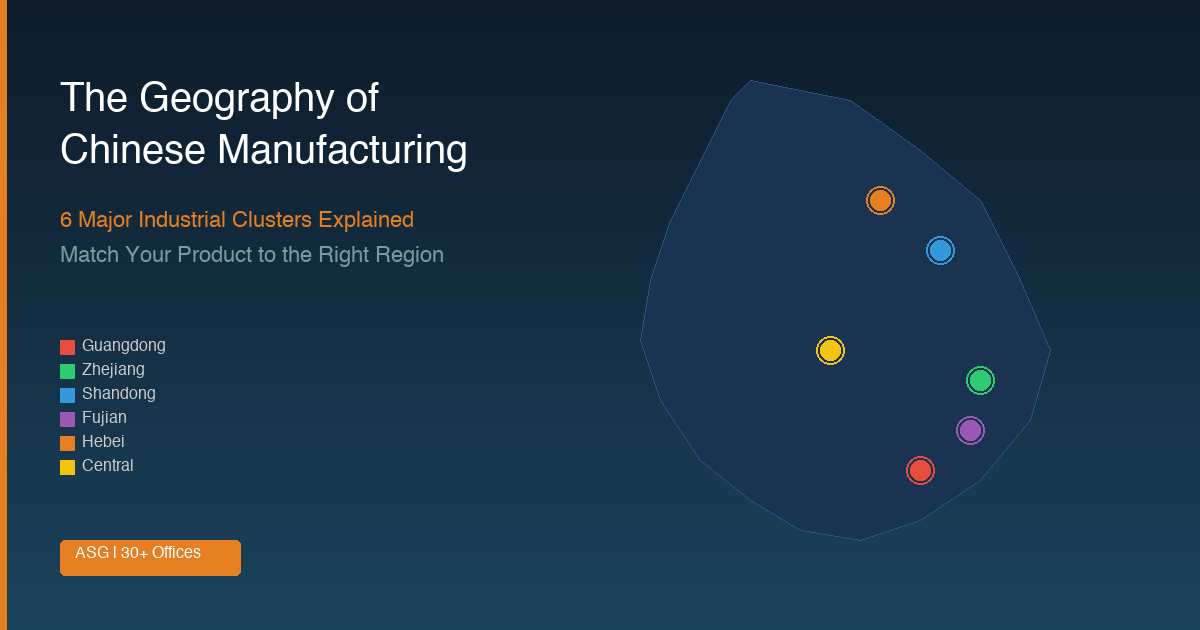
China’s Six Major Manufacturing Belts

Let’s walk through six major manufacturing regions relevant to international buyers, with guidance on their common strengths and the factors buyers should consider when sourcing from each.
1. Pearl River Delta (Província de Guangdong)
The Pearl River Delta is China’s most mature export-oriented manufacturing cluster. Cities like Shenzhen, Dongguan, Foshan, and Zhongshan have decades of experience serving international buyers, and the supply chain ecosystem here is arguably the most complete in the world for consumer products.
| Dimension | Characteristics |
|---|---|
| Key cities | Shenzhen, Dongguan, Foshan, Zhongshan, Cantão |
| Strong categories | Eletrônica (Shenzhen), Iluminação LED (Shenzhen/Zhongshan), mobília (Foshan), hardware (Dongguan), cerâmica (Foshan), vestuário (Guangzhou/Humen) |
| Quality positioning | Mid-to-high end export; strongest quality awareness nationally |
| Price level | Highest in China; but best quality-to-price ratio |
| Quantidade mínima | Flexível (500-1,000 pcs commonly accepted) |
| Lead time | Estável (complete local supply chain minimizes material delays) |
| Melhor para | Brand owners, quality-sensitive buyers, products requiring international certifications |
If your product needs consistent quality, export certifications, and responsive English-speaking service, even at a 15-20% prêmio de preço, Guangdong is the default choice. For a deeper look at specific supplier categories in this region, nosso guia sobre top lighting suppliers in China profiles the Shenzhen/Zhongshan ecosystem specifically.
2. Delta do Rio Yangtze (Zhejiang + Jiangsu)
The Yangtze River Delta is China’s second manufacturing powerhouse, but it operates differently from Guangdong. The critical distinction: Yiwu and Ningbo, though in the same province, serve completely different market segments.
| Dimension | Poderia | Ningbo/Suzhou |
|---|---|---|
| Positioning | Low-cost bulk goods capital of the world | Mid-to-high precision manufacturing |
| Strong categories | Pequenas commodities, promotional items, basic hardware (Yongkang) | Molds/injection (Huangyan), eletrônica, maquinaria |
| Preço | Lowest nationally | Mid-range to premium |
| Quantidade mínima | Extremely flexible (100 pcs OK) | Padrão (1,000-3,000 peças) |
| Melhor para | Vendedores da Amazon, market testing, promotional products | Quality-focused buyers in hardware, ferramentas, molded parts |
ASG maintains a presence across this belt, including Ningbo, Jiashan, Jinhua (Poderia), Suzhou, Nanquim, and Yangzhou. This coverage helps buyers navigate the different manufacturing specialties found across Zhejiang and neighboring provinces. Understanding whether your product belongs in Yiwu’s small-commodity ecosystem or Ningbo’s precision manufacturing zone can save you significant cost and quality headaches.
3. Província de Shandong
Shandong has a strong base in heavy industry and bulk materials. Its particular strengths include industrial categories where production scale and access to raw materials are important.
| Dimension | Characteristics |
|---|---|
| Key cities | Qingdao, mulheres, Dongying, Binzhou (Boxing) |
| Strong categories | Tires/rubber, produtos químicos, equipamento de cozinha (Boxing), glass products, agricultural processing, têxteis |
| Quality positioning | Functional industrial quality; less export-refined than Guangdong |
| Preço | Competitive for bulk commodities and raw materials |
| Quantidade mínima | Typically high (accustomed to large-volume orders) |
| Lead time | Moderado (logistics less convenient than coastal Guangdong) |
| Melhor para | Industrial product buyers, chemical/rubber sourcing, commercial kitchen equipment |
Shandong’s competitive advantage is raw material proximity and scale, not service sophistication. If you’re sourcing consumer goods like furniture or electronics, this region typically isn’t the optimal choice. But for industrial products, tires, vidro, or commercial kitchen equipment, Shandong offers unbeatable economics.
4. Província de Fujian
Fujian is a category-specialist region, not everything, but the categories it dominates, it leads nationally and often globally.
| Dimension | Characteristics |
|---|---|
| Key cities | Quanzhou (Jinjiang), Zhangzhou, Xiamen, Nan'an |
| Signature categories | Athletic shoes (Jinjiang produces 60% of China’s sports shoes), stone products (Nan'an), louças sanitárias (Nan'an), food processing |
| Why it dominates | Decades of category specialization created unmatched supplier density and cost competition |
| Preço | Highly competitive within its specialty categories |
| Melhor para | Athletic/casual footwear, stone countertops/tiles, bathroom fixtures |
The lesson from Fujian: sometimes the best sourcing region isn’t the biggest or most famous; it’s the one with the deepest category expertise. If you’re buying athletic shoes and you’re not looking at Jinjiang, you’re likely overpaying or working with an intermediary.
5. Hebei + Tianjin (Northern Industrial Belt)
This region is China’s lowest-cost manufacturing zone; but comes with corresponding risk factors that buyers must actively manage.
| Dimension | Characteristics |
|---|---|
| Key cities | Cangzhou, Tianjin, Shijiazhuang, Baigou |
| Strong categories | Steel products, castings, pipes/valves, vidro (Shahe), bags/luggage (Baigou) |
| Preço | Lowest nationally; but price reflects quality variability |
| Key risk | Environmental inspections and compliance requirements may affect some industries; quality consistency should be verified through supplier audits and inspections. |
| Melhor para | Price-sensitive bulk standard goods where buyer has own QC capacity |
Hebei works for buyers who have quality inspection teams on the ground and are comfortable managing higher operational risk for lower unit costs. It does not work for brands requiring consistent export-grade quality without intensive oversight. If you’re considering this region, nosso guia sobre factory verification methods is particularly relevant.
6. China Central (Hubei + Hunan)
Central China represents the “cost valley”, emerging manufacturing zones where lower labor costs and government incentives are attracting factories relocating from the expensive coastal regions.
| Dimension | Characteristics |
|---|---|
| Key cities | Wuhan, Changsha |
| Strong categories | Auto parts (Wuhan), heavy machinery (Changsha, SANY/Zoomlion headquarters), optoelectronics |
| Preço | 10-20% below coastal regions for comparable categories |
| Lead time consideration | 5-7 days additional inland transport to ports; adds ¥5,000-8,000 per container |
| Melhor para | Cost-sensitive buyers accepting longer lead times; peças automotivas; equipamento pesado |
Source From the Right Region, Not Just the Cheapest Quote
Central China’s lower FOB prices are real; but the logistics penalty is real too. When you add inland transportation and the extra week of transit time, the total cost advantage narrows from 15-20% para aproximadamente 5-10%. For high-volume, low-urgency orders, it’s worth considering. For time-sensitive or quality-critical products, the coastal advantage remains.
How to Match Your Product to the Right Region

Here’s a quick-reference matching table to help you identify the optimal sourcing region before you start contacting suppliers:
| Categoria de produto | Primary Region | Secondary Option | Considerações |
|---|---|---|---|
| Eletrônicos de consumo / LIDERADO | Shenzhen / Dongguan | Ningbo | Hebei / Shandong |
| Mobília (mid-to-high end) | Foshan / Dongguan | Suzhou | Poderia / Hebei |
| Mobília (budget bulk) | Poderia / Angie | Hebei | Shenzhen (overpriced for this tier) |
| Hardware / ferramentas | Yongkang (Jinhua) | Dongguan | Shandong |
| Fashion apparel | Cantão / Humen | Wenzhou | Hebei |
| Athletic footwear | Quanzhou / Jinjiang | Cantão | Poderia |
| Plástico / injection parts | Ningbo (Huangyan) | Dongguan | Shandong |
| Cerâmica / louças sanitárias | Foshan / Chaozhou | Nan'an | Hebei |
| Aço / castings | Hebei / Shandong | Nenhum | Guangdong (not competitive) |
| Pequenas commodities / em geral | Poderia | Cantão | Nenhum |
| Stone products | Nan'an (Fujian) | Shandong | Nenhum |
O “Region Mismatch” Problema
The most common error in China sourcing is buying from the wrong region; and it’s usually caused by looking only at price:
- Buying “high-end custom furniture” from Hebei → Price is low but quality can’t meet export standards; you end up paying for rework or accepting returns.
- Buying “budget promotional items” from Shenzhen → Shenzhen’s operating costs mean it can’t be the cheapest option; you’re overpaying for quality you don’t need.
- Buying “eletrônica complexa” from Yiwu → Yiwu’s ecosystem is built for simple, standardized goods; technical complexity isn’t its strength.
A correção: determine your product’s “home region” first, then find suppliers within that region. Don’t reverse the process.
The Price-Quality-Region Triangle

Let’s make this concrete with a real example. Take an office task chair, the same physical product, sourced from three different regions:
| Region | FOB Price Range | Quality Positioning | Typical Buyers |
|---|---|---|---|
| Foshan / Dongguan | $55-90 | Premium export quality, BIFMA certified, full testing documentation | European/US brands, hotel chains, corporate procurement |
| Angie (Zhejiang) | $35-55 | Mid-range quality, partial certifications | Vendedores da Amazon, mid-tier retailers, office supply chains |
| Hebei / Shandong | $20-35 | Budget quality, high variability, limited certifications | Price-sensitive markets, promotional giveaways, emerging market export |
All three chairs may look identical in product photos. The difference is in the foam density, the gas lift certification, the fabric durability, and the consistency across a 5,000-unit order. The chairs aren’t the same product; they just share the same name.
When to Pay the Region Premium
The extra 10-20% for a premium manufacturing region is justified when:
- Your target market has mandatory certification requirements (EU REACH, US BIFMA, Australian standards).
- Your brand positioning cannot tolerate quality variation.
- Your order volume is moderate (sob 10,000 unidades) and you need factory flexibility.
- You require frequent specification changes and rapid sample turnaround.
- Defect costs are high (warranty claims, retorna, brand damage).
When Low-Cost Regions Make Sense
Budget regions work when:
- The product is a standardized commodity (standard screws, basic plastic bags, simple castings).
- You have your own QC team capable of on-site inspection.
- Your order volume is large enough (50,000+ unidades) that the factory will commit to your specifications.
- Your target market has relaxed certification requirements.
- You’re testing a market and need low investment to validate demand.
How Region Affects Lead Time and Logistics
Your supplier’s location determines how far goods must travel before they reach a port; and this inland leg adds both cost and time that many buyers overlook:
| Manufacturing Region | Nearest Port | Inland Transit | Inland Cost (20GP container) |
|---|---|---|---|
| Shenzhen / Dongguan | Yantian / Shekou | 1-2 dias | ¥1,500-2,500 |
| Foshan / Zhongshan | Guangzhou Nansha | 1-2 dias | ¥2,000-3,000 |
| Poderia / Zhejiang | Ningbo | 2-3 dias | ¥2,500-3,500 |
| Shandong | Qingdao | 1-2 dias | ¥1,500-2,500 |
| Hebei | Tianjin | 2-3 dias | ¥2,000-3,000 |
| Wuhan / Changsha | Shanghai or Shenzhen (inland) | 5-7 dias | ¥5,000-8,000 |
The inland logistics penalty is why Central China’s FOB advantage is smaller than it appears. A chair from Wuhan might be $5 cheaper at the factory gate; but after ¥6,000 in additional inland transport and a week of extra lead time, the real savings may be negligible.
For a complete breakdown of how to calculate total landed cost including these regional logistics differences, nosso guia de custos de fornecimento verdadeiro covers the full methodology.
Using Regional Knowledge in Supplier Selection
Here’s how to apply this geographic intelligence in your actual sourcing workflow:
Etapa 1: Determine Your Product’s “Home Region”
Use the matching table above to identify which region specializes in your product category. If a potential supplier is located outside that region, ask why. There may be legitimate reasons (a new factory with better pricing, a subsidiary operation); but it’s a flag worth investigating.
Etapa 2: Validate Region-Price Alignment
Once you receive quotes, compare them against the typical price range for that region. Red flags:
- Price significantly below regional norms → Likely a trading company reselling from a lower-tier region, or quality is being compromised.
- Price significantly above regional norms → May be justified by premium quality, or may indicate inflated pricing from an intermediary.
Etapa 3: Check Supply Chain Completeness
Ask your supplier: “Are your key raw materials and components sourced locally, or do they ship in from other provinces?”
- Fornecimento local = stable delivery, quick material replenishment, lower logistics risk.
- Remote sourcing = potential delays, vulnerable to transport disruptions, higher hidden costs.
A factory in Dongguan surrounded by component suppliers will consistently outperform an isolated factory that must ship every input from elsewhere, even if the isolated factory quotes a lower price.
Etapa 4: Factor in Risk Profile
Each region carries different operational risks:
- Environmental policy risk: Hebei > Shandong > Central > Guangdong (Guangdong has the most mature environmental compliance infrastructure, meaning fewer surprise shutdowns).
- Peak season capacity risk: Dongguan and Yiwu can become fully booked during Q3 rush, consider secondary regions as overflow options.
- Labor stability risk: Inland regions experience higher worker turnover as labor migrates back toward coastal areas; long-term production consistency may be affected.
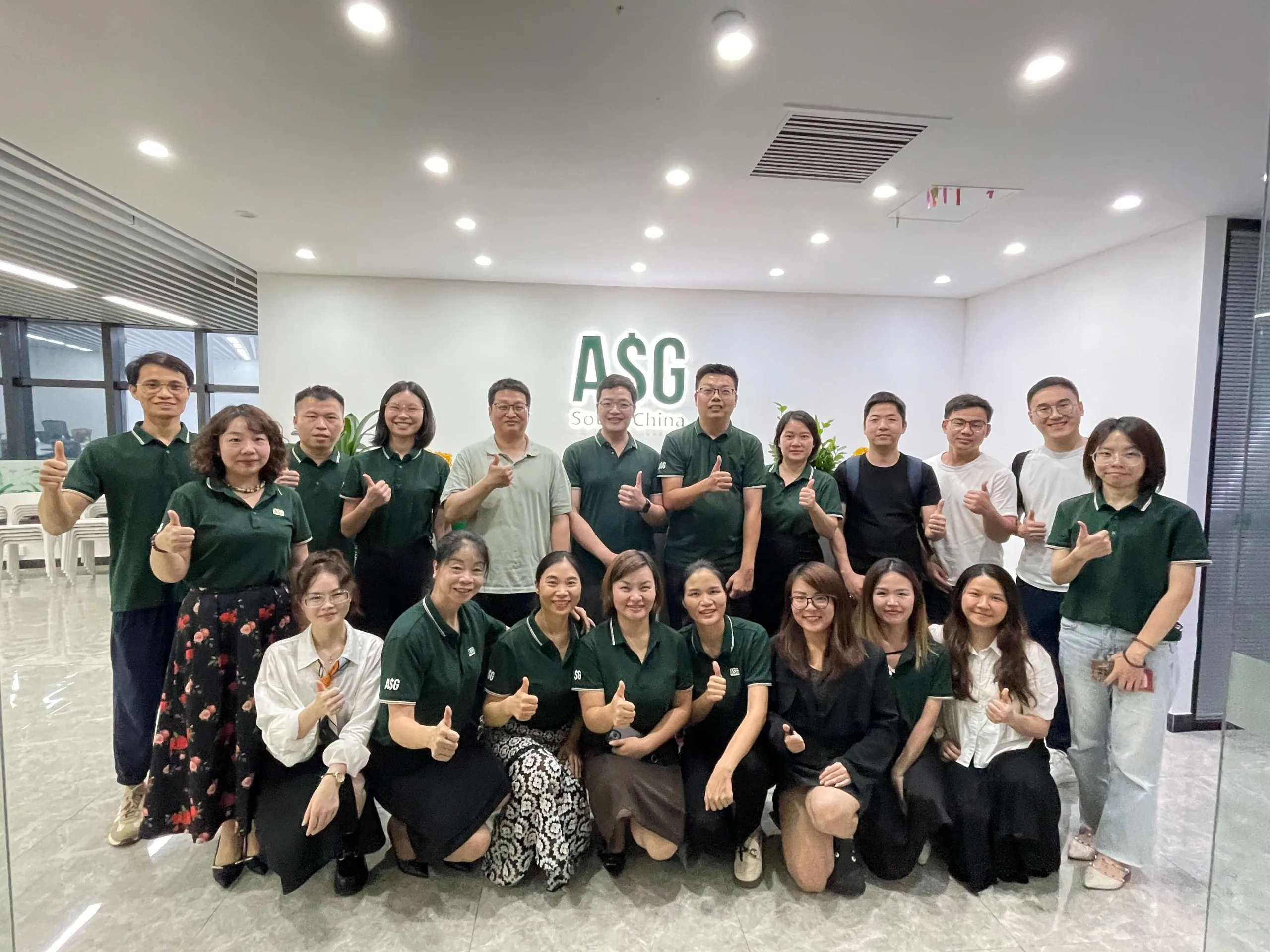
Why ASG’s 30+ Office Network Matters for Multi-Region Sourcing
Managing suppliers across different regions requires local presence, which is exactly why ASG built a network of 25+ offices covering every major manufacturing belt:
- Guangdong (9 escritórios): Shenzhen, Dongguan (2), Foshan (2), Zhongshan, Shantou, Cantão (2).
- Zhejiang (5 escritórios): Ningbo (3), Jiashan, Jinhua.
- Jiangsu (3 escritórios): Suzhou, Nanquim, Yangzhou.
- Shandong (3 escritórios): Binzhou, Dongying, mulheres.
- Hebei + Tianjin (3 escritórios): Cangzhou (2), Tianjin.
- Fujian, Hunan, Hubei (3 escritórios): Zhangzhou, Changsha, Wuhan.
This geographic coverage means:
- 24-hour factory audit response in any major manufacturing region, no matter where your supplier is located.
- Accurate regional pricing intelligence; we know the real cost structure in each cluster, so you’re never misled by inflated quotes.
- Cross-region benchmarking; we can simultaneously quote your product from multiple regions, giving you a complete picture of your options.
- Otimização logística; we match your product to the most efficient port based on factory location and your destination market.
Whether you need help evaluating suppliers across regions or want to understand how to manage a multi-region supply chain remotely, our team covers every major production zone. For a broader look at building diversified supply networks, nosso guia da cadeia de suprimentos multifábrica provides the operational framework.
Not sure which Chinese manufacturing region fits your product? → Our regional specialists can match your category to the optimal sourcing cluster; and validate suppliers on the ground within 24 horas.
Perguntas frequentes
Is Guangdong always the best region for sourcing from China?
Não. Guangdong leads in electronics, mobília, iluminação, and other mid-to-high-end export categories. But Yiwu dominates small commodities, Fujian leads in athletic footwear and stone products, Shandong excels in heavy industry and chemicals, and Hebei offers the lowest prices for basic steel products. O “melhor” region depends entirely on your product category and target market positioning.
Why are prices so different between regions for the same product?
Four factors drive regional price differences: (1) local labor costs, Guangdong wages are 30-50% higher than Hebei; (2) supply chain completeness, regions with local component suppliers have lower input costs; (3) quality positioning, premium regions invest in better materials, testando, e certificações; (4) competitive density, Yiwu’s extreme competition drives prices down for standardized goods.
Can I get good quality from lower-cost regions like Hebei?
Sim, but it requires active quality management. Hebei works well for standardized industrial products (castings, tubos de aço, basic hardware) when combined with on-site QC inspection. It’s less suitable for complex consumer products requiring consistent export-grade quality, international certifications, or flexible communication. The lower the region’s export sophistication, the more QC oversight you need to provide.
How do I verify a supplier is actually located where they claim?
Check three things: (1) their business license registered address, (2) their factory’s physical location via Google Maps satellite view, e (3) shipping documents showing the actual departure point. Se um “Shenzhen supplier” is actually warehousing in Dongguan or Huizhou, that’s normal (many do). But if a “Guangdong factory” ships from Hebei, they’re likely a trading company reselling from a lower-cost region.
Does the manufacturing region affect product certification and compliance?
Significativamente. Export-oriented regions like Guangdong and Zhejiang have factories that maintain CE, FCC, ALCANÇAR, RoHS, and BIFMA documentation as standard practice. Factories in primarily domestic-oriented regions (Hebei, parts of Shandong) may lack experience with international compliance requirements, requiring you to invest more time in certification guidance, or face shipment rejections at destination customs.