
Updated April 2026. Manufacturer data and export figures reflect current production and market position.
Looking for a reliable air conditioner supplier? China offers top-quality, energy-efficient, and affordable AC units for every need. Check out the top 10 manufacturers, known for their strong production and global reach.
Why Chinese AC Manufacturing Leads the World (and Why It Matters in 2026)
Chinese air conditioner dominance is structural, not incidental. Guangdong Province alone accounts for over 50% of China’s total AC exports — and within Guangdong, Foshan and Zhuhai house the global headquarters and primary production facilities of the world’s three largest AC manufacturers by unit volume.
The concentration of the supply chain is the key: compressor manufacturers, electronics suppliers, refrigerant producers, and logistics providers are all co-located within a few hours of the major factories. This is why Chinese manufacturers can achieve unit production costs that Western or Japanese manufacturers operating in higher-cost environments cannot approach.
For buyers in 2026, the relevant question is not whether to engage with Chinese-manufactured AC equipment, but which manufacturers produce equipment appropriate for their specific application, market, and compliance requirements.
Top 10 Air Conditioner Manufacturers in China
Here is a simple look at what makes each air conditioner manufacturer different:
| Manufacturer | Main Strengths | Unique Features | Market Position |
|---|---|---|---|
| Gree | Largest AC maker in China | Strong R&D, energy-saving tech | Global leader in split ACs |
| Midea | Wide product range, smart tech | Robotics, smart home integration | Top global home appliance brand |
| Haier | Strong overseas factories | Smart VRF systems, intelligent controls | Leading brand in Asia, Africa, and Europe |
| AUX | Large factories, worldwide R&D | Strong exports to the US, Japan, and Australia | Fast-growing Chinese AC brand |
| Hisense | Broad electronics portfolio | Smart features, Mexico AC plant | Major global supplier with expanding reach |
| Chigo | Affordable pricing | Energy-efficient residential & commercial ACs | Exporter to 200+ countries |
| TCL | Global electronics group | Multi-brand strategy (TCL, Alcatel, RCA) | Strong global presence in AC & electronics |
| OUTES | HVAC specialization | Heat pumps, ventilation systems, patents | Emerging provider of energy-efficient solutions |
| Chunlan | Large-scale production | Durable ACs, compressors, energy systems | Established Chinese high-tech enterprise |
| Xiaomi | Affordable smart devices | Stylish ACs with IoT and app control | Rising brand in the smart AC market |
Gree Electric Appliances Inc.
- Founded in 1991 in Zhuhai, Guangdong: Gree started with home air conditioners and has grown into China’s biggest AC maker, now leading globally in split systems.
- Innovation and product range: Gree also makes refrigerators, water heaters, and smart devices, investing heavily in energy-saving technology and R&D.
- Global scale: With 14 factories worldwide, including Brazil and Pakistan, Gree produces over 6.5 million units each year and exports to more than 160 countries.
Gree, headquartered in Zhuhai, Guangdong, is the single largest air conditioner manufacturer in the world by unit volume, a position it has held since 2005. Its 2024 export figures were estimated at approximately USD $16 billion, roughly double those of its nearest competitor.
What distinguishes Gree from every other manufacturer on this list is its near-complete vertical integration: Gree manufactures the compressors, motors, electronic controls, refrigerant valves, and finished units in-house. This means Gree’s quality consistency is unusually high for its price point — there is no component supply variability from external vendors, because there are almost no external vendors.
What Gree excels at: Residential split systems and inverter technology. Gree’s inverter AC units have a strong reputation for cooling efficiency and reliability. For importers, Gree’s export infrastructure is well-developed — they are accustomed to CE, ETL, and other certification requirements.
Main product categories: Residential split systems, multi-split systems, commercial VRF systems, portable AC, air purifiers.
Export markets: US, Europe, Southeast Asia, Middle East, Africa. Products are sold under the Gree name and under the TOSOT sub-brand.
Headquarters / primary manufacturing: Zhuhai, Guangdong Province.
Midea Group Co., Ltd.
- Founded in 1968, entered home appliance market in 1980: Midea started as a small factory and has grown into a top air conditioner maker.
- Wide product range and innovation: The company offers ACs, refrigerators, washing machines, and focuses on smart home technology and robotics.
- Global presence and scale: Serving over 400 million users, Midea operates large production facilities and owns 200 subsidiaries, including Little Swan and Toshiba.
Midea, headquartered in Foshan, Guangdong, is China’s largest home appliance conglomerate and the second-largest AC manufacturer globally by volume. Its air conditioning division alone generated over CNY 161 billion (approximately USD $22 billion) in revenue in 2023.
Midea’s strategic position is meaningfully different from Gree’s. While Gree focuses on its own brand at scale, Midea operates extensively as an OEM and ODM manufacturer for international brands. It co-develops HVAC technology with Toshiba and has partnership arrangements with Carrier Global. This means that “Midea” and “branded Western equipment with Midea technology inside” often represent different commercial propositions for buyers.
The company also holds a 95% stake in KUKA Group, Germany’s leading industrial robotics manufacturer, which has accelerated Midea’s factory automation and precision manufacturing capability significantly.
What Midea excels at: Inverter technology (widely regarded as the best inverter AC in the Chinese domestic market), smart home integration (Wi-Fi control, AI energy management), and consistent quality at volume. The broadest technology range of any Chinese manufacturer.
OEM significance: If you are evaluating white-label or private-label AC sourcing, Midea is the primary candidate for mid-to-high specification product with documented export compliance history.
Main product categories: Residential split, multi-split, portable, cassette, commercial VRF, chillers.
Headquarters / primary manufacturing: Foshan/Beijiao, Guangdong; additional production bases in Vietnam, India, Egypt, Brazil, Argentina.
Haier Group Corporation
- Founded in 1984: Haier is a leading air conditioner brand, known for innovation and high-quality products.
- Global production and expansion: With factories worldwide, including Egypt (producing 1.5 million units annually for Africa, the Middle East, and Europe), Haier plans to produce 6 million units at its Thailand facility by 2027, half for ASEAN markets.
- Advanced technology: The company offers smart VRF systems and intelligent controls, providing advanced features that enhance user experience.
- Industry leadership: Haier’s large-scale production and global reach solidify its top position in the air conditioner market.
Haier, headquartered in Qingdao, Shandong, is the world’s largest home appliance company by revenue. Its HVAC and AC business operates under multiple brand names that international buyers may not immediately associate with a Chinese manufacturer:
- Haier — the core brand
- GE Appliances — acquired by Haier in 2016; GE-branded AC sold in the US is manufactured by Haier
- Casarte — premium sub-brand
- Fisher & Paykel — New Zealand brand, acquired 2012
- Candy — Italian brand, acquired 2019
This multi-brand architecture is the key commercial fact about Haier for importers: the GE Appliances brand in the US market is Chinese-manufactured Haier equipment. For buyers who need “American brand” positioning with Chinese manufacturing economics, Haier/GE is the established route.
What Haier excels at: Brand portfolio breadth, after-sales and spare parts infrastructure (important for commercial or hospitality applications where service continuity matters), and smart home ecosystem integration.
Main product categories: Residential split, window AC, portable, commercial VRF, heat pumps, chillers.
Headquarters / primary manufacturing: Qingdao, Shandong; regional headquarters in New York, Paris, Tokyo.
AUX Group
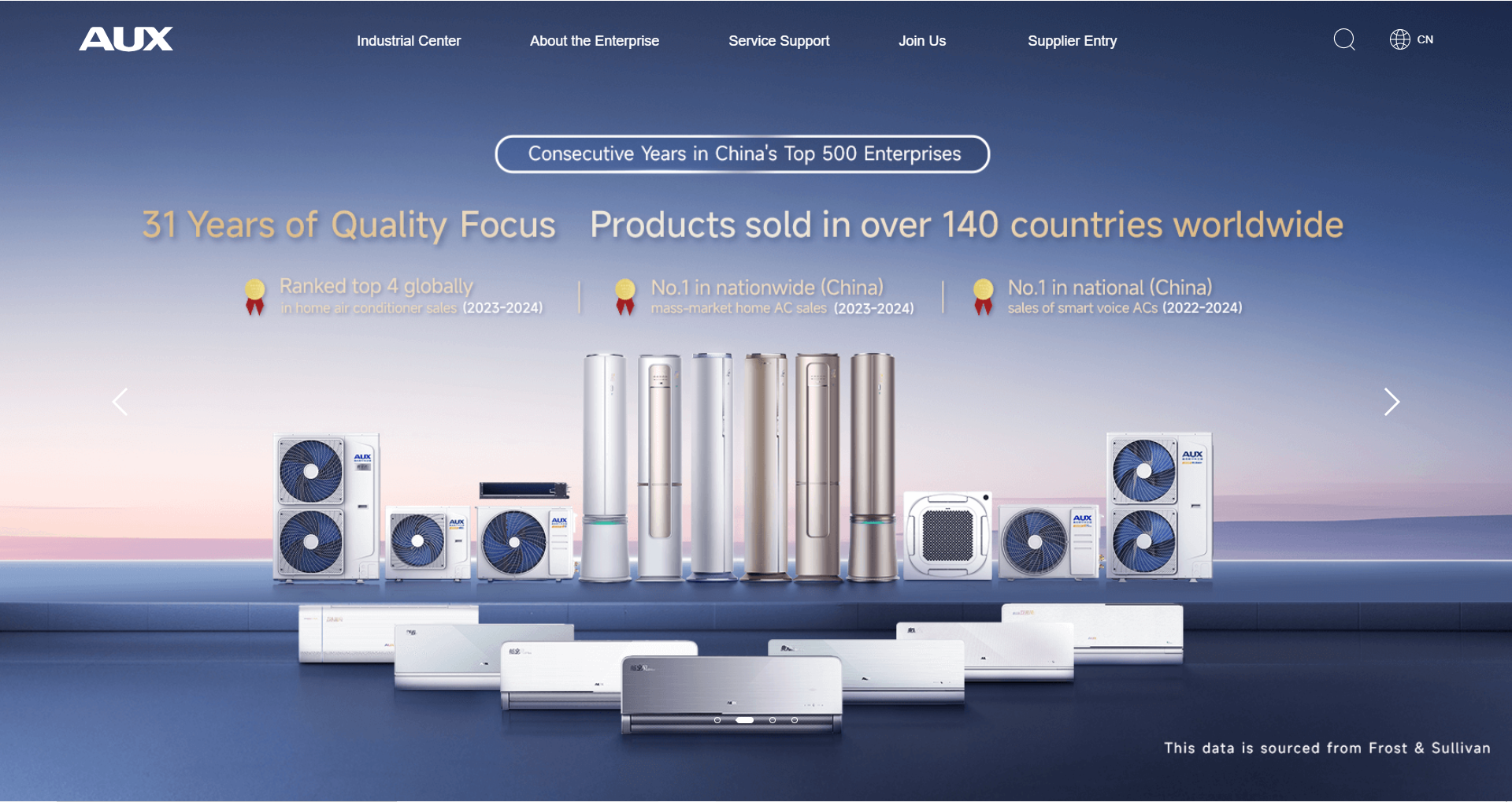
- Founded in 1986 in Ningbo, Zhejiang: AUX began making air conditioners in 1994 and quickly became a top AC maker in China.
- Diverse product range: The company also produces electric meters, transformers, mobile phones, and small home appliances.
- Global scale and R&D: AUX operates 11 air conditioner factories and 6 R&D centers worldwide.
- International sales: AUX sells to over 19 countries, with the United States, Japan, and Australia accounting for 79% of exports.
- Strengths: Known for large factories and strong overseas sales, AUX combines production capacity with global reach.
Hisense Group
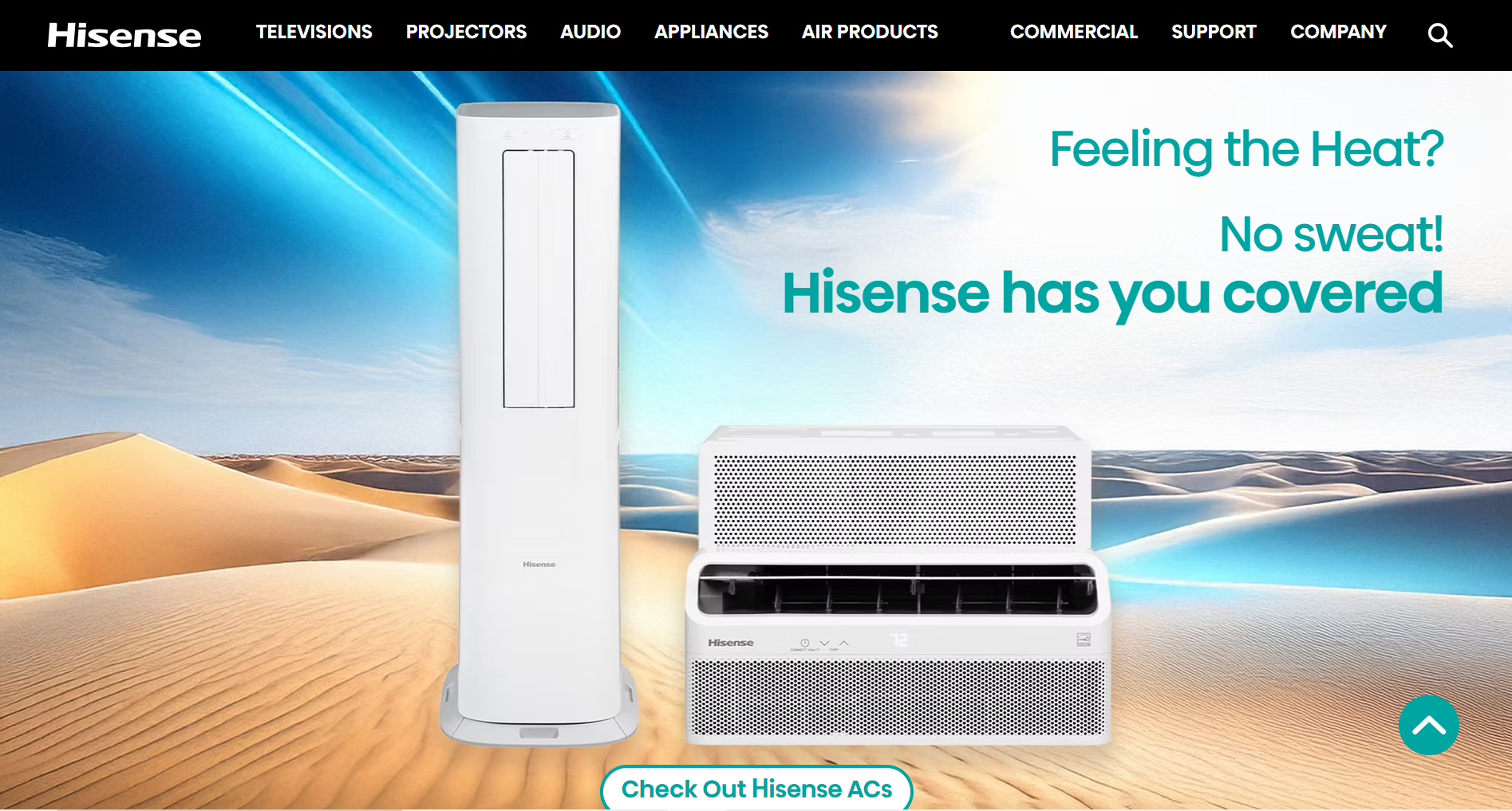
Hisense, also headquartered in Qingdao, Shandong (the same city as Haier), is one of China’s major consumer electronics and home appliance manufacturers. Its AC division has grown substantially over the past decade and holds meaningful market share in Southeast Asia, Africa, and Eastern Europe.
Hisense positions itself at the quality-consistent mid-tier: not the cheapest option, but a more reliable specification-to-delivery consistency than pure budget manufacturers. Its export business is substantial — factories in Huzhou handle significant AC export volume from September through April annually.
What Hisense excels at: Reliability consistency at mid-tier price points; good compliance documentation for CE markets; strong distribution networks in Africa and Eastern Europe.
Main product categories: Residential split, multi-split, commercial VRF.
Chigo Air Conditioning Co., Ltd.
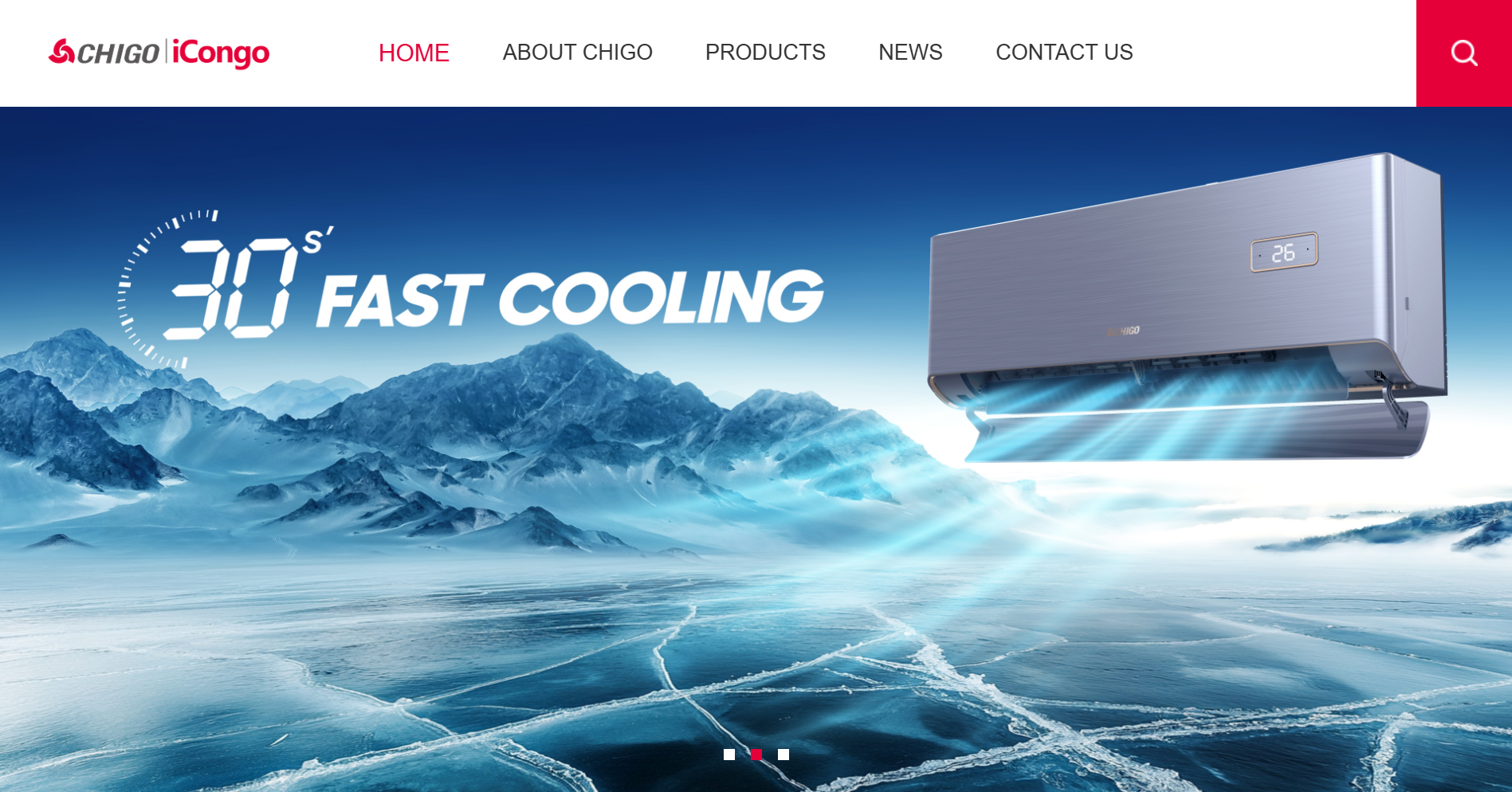
Chigo (Guangdong Chigo Air Conditioning Co., Ltd.), headquartered in Nanhai District, Foshan, was founded in 1994 and has production capacity of 10 million AC units annually across facilities in Foshan, Jiujiang, and Sihui. It exports to over 200 countries.
Chigo’s commercial positioning is explicitly volume-oriented: it targets cost-sensitive markets, particularly in Africa, Southeast Asia, South Asia, and Latin America, where price competitiveness outweighs brand recognition. Its TCL-brand partnership has further extended its commercial reach.
What Chigo excels at: Budget wholesale, fast-moving SKUs, high production volume with fast lead times. Chigo uses Toshiba compressors in several product lines, which is a quality signal in a generally budget-oriented lineup.
Important caveat for importers: Chigo’s quality consistency varies more than Midea or Gree. Pre-shipment inspection and tight specification documentation are more important when sourcing from Chigo than from Tier 1 manufacturers. The unit cost advantage is real, but the quality management overhead is higher.
Headquarters / primary manufacturing: Nanhai District, Foshan, Guangdong Province.
TCL Technology Group Corporation
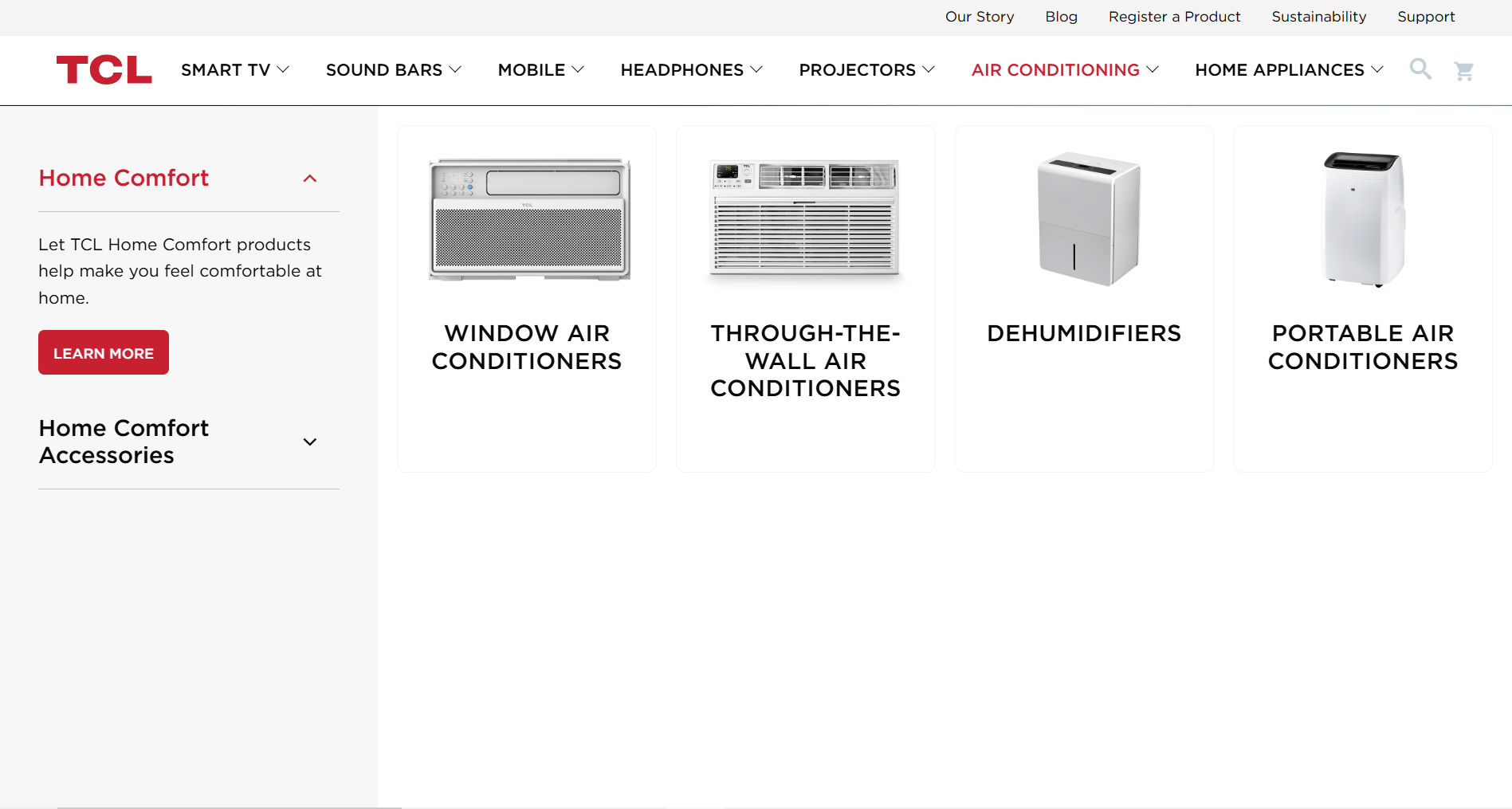
- Founded in 1981 as TTK, became TCL in 1985: TCL evolved from an audio cassette maker into a global consumer electronics and air conditioner brand.
- Product range: The company produces air conditioners, TVs, mobile phones, home appliances, and lighting, selling under TCL, Alcatel Mobile, Thomson, and RCA.
- Modern production and technology: TCL’s AC factories use advanced technology to manufacture a wide range of products.
- Global presence: Selling worldwide, TCL stands out for innovation and strong exports in the global market.
OUTES Group
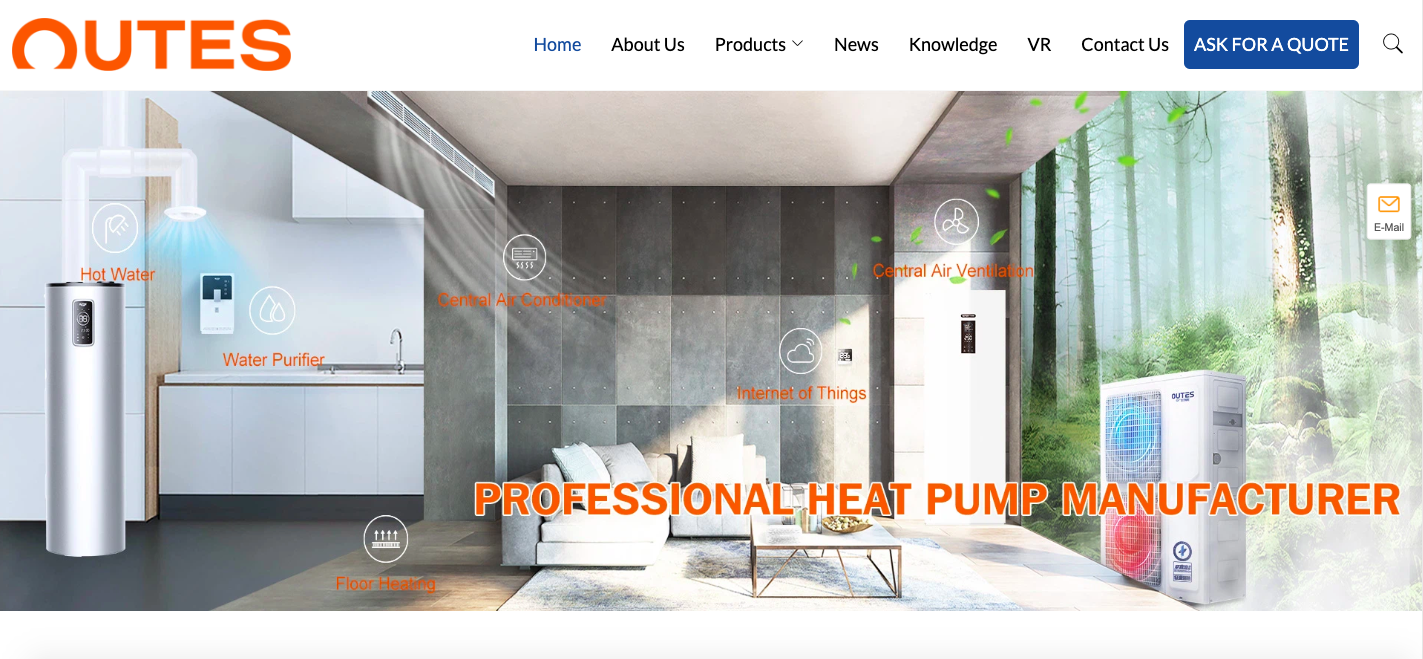
- Founded in 2006 in Lishui, Zhejiang Province: OUTES specializes in HVAC products, including air conditioners, heat pumps, and ventilation systems.
- Innovation and R&D: With over 600 engineers and multiple R&D centers, the company holds national patents and high-tech certifications.
- Quality and production: In-house manufacturing and testing ensure reliable, energy-efficient products.
- Global reach: OUTES exports to many countries, gaining a reputation for dependable HVAC solutions.
Chunlan (Group) Corporation
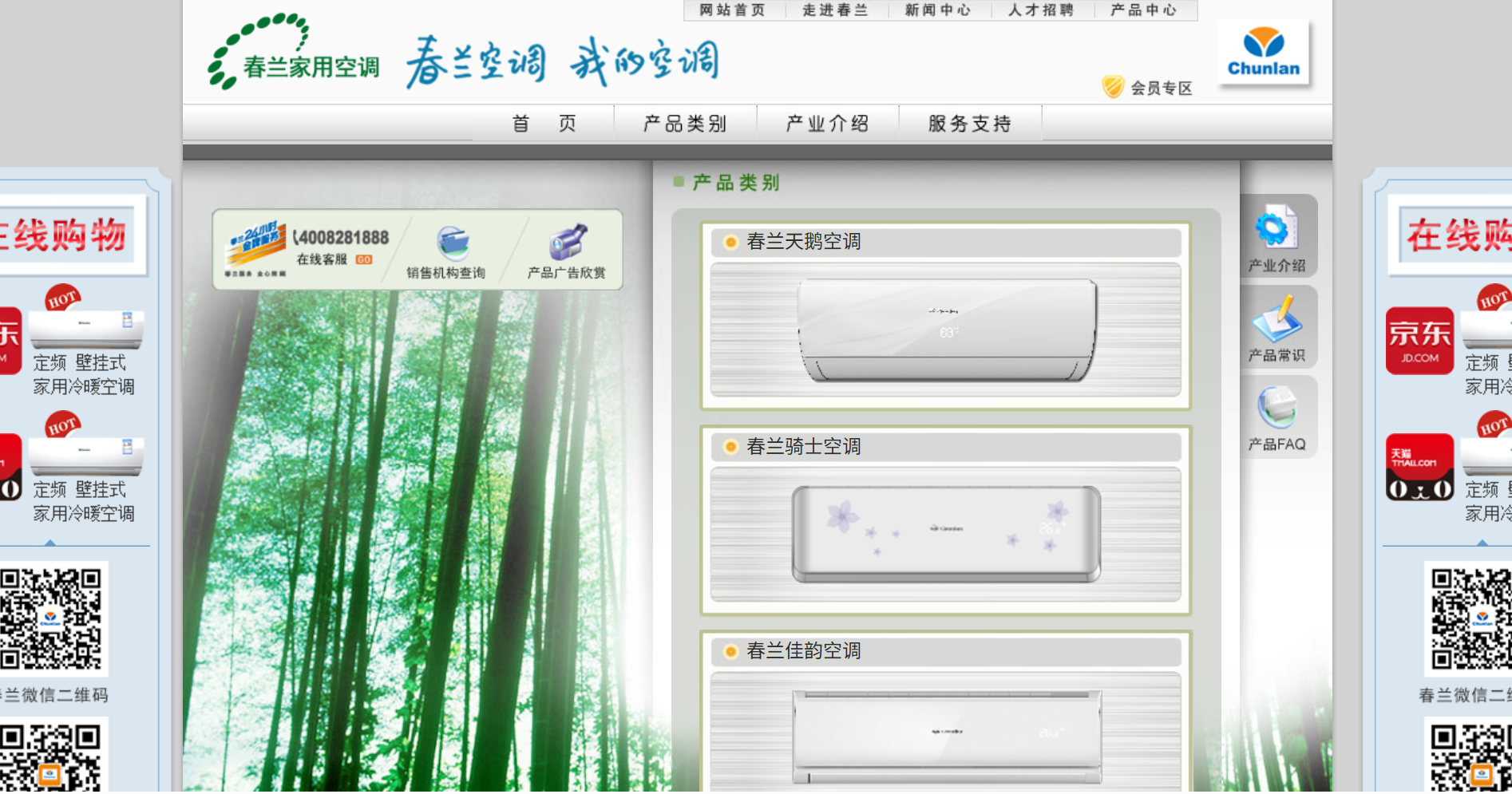
- Founded in 1998 in Taizhou, Jiangsu Province: Chunlan produces residential and commercial air conditioners.
- Product range and innovation: The company also makes compressors, dehumidifiers, and energy systems, earning multiple innovation and quality awards.
- Energy efficiency and reliability: Chunlan is known for durable, energy-efficient AC units.
- Industry reputation: Large-scale production and strong market presence make Chunlan one of China’s top air conditioner brands.
For anyone trying to trace the manufacturing origin of specific branded AC equipment in Asia, Chunlan is a name that appears in the supply chain of several brands that consumers and buyers assume are Japanese or American-manufactured.
What Chunlan excels at: OEM manufacturing for branded international clients; established quality systems for high-profile OEM requirements.
Manufacturing scale: 4 production bases, 15 assembly lines, 3 million units annual capacity.
Xiaomi Corporation
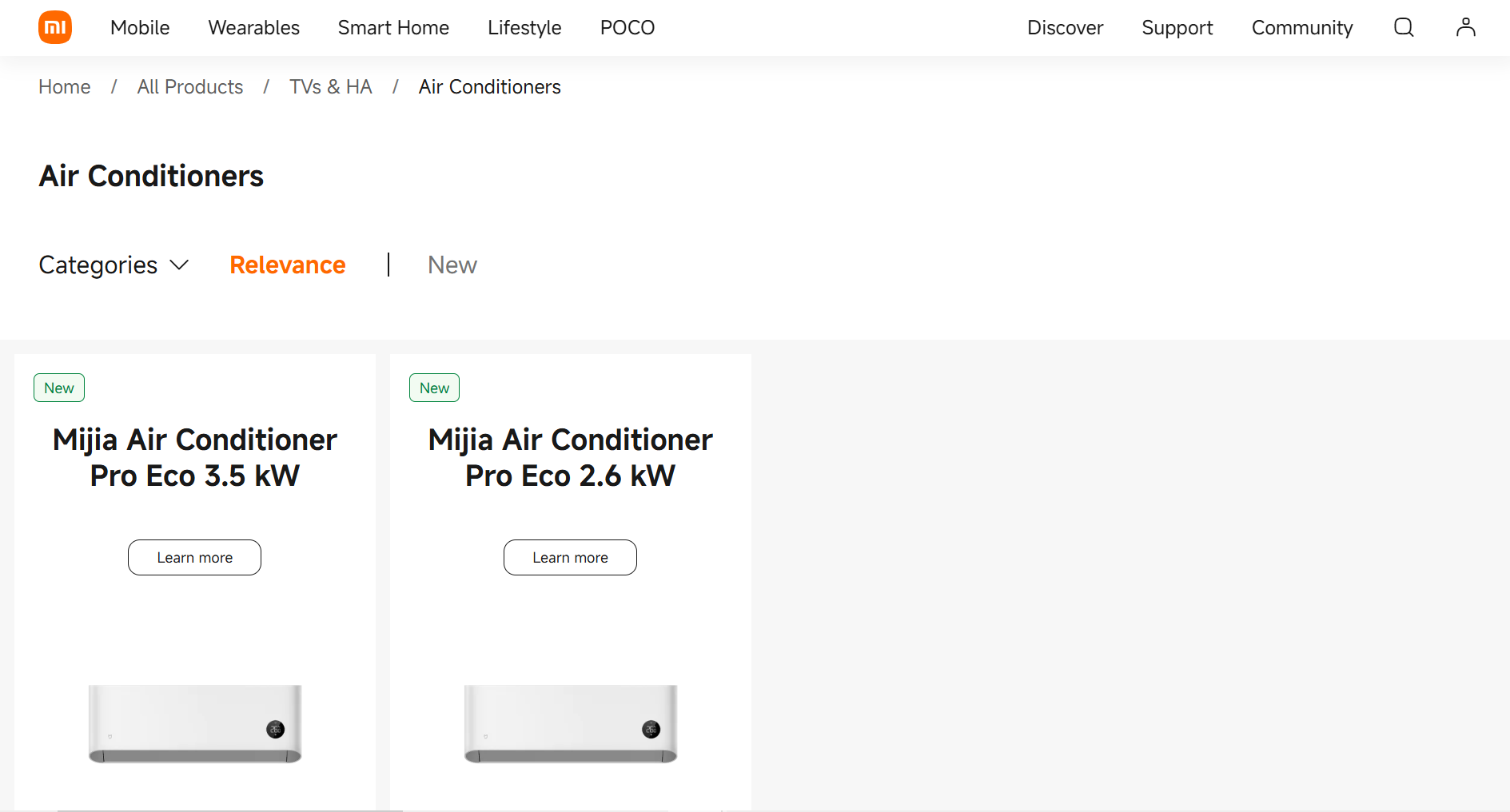
- Founded in 2010 in Beijing: Xiaomi is a leading smart electronics brand that has entered the air conditioner market.
- Smart and energy-efficient products: The company offers stylish, energy-saving AC units with intelligent controls and mobile app integration.
- Affordability and innovation: Xiaomi combines affordable pricing with smart technology to meet modern consumer needs.
- Rising presence: As an emerging player, Xiaomi is gaining recognition among China’s top air conditioner manufacturers.
Which Chinese Manufacturer Is Behind Which Western Brand
This is the section most “Chinese AC manufacturers” guides don’t include — and it’s what many buyers actually need to know.
GE Appliances (US): Owned by Haier since 2016. GE-branded air conditioners sold in the US are manufactured by Haier.
Carrier (partial): Midea co-develops HVAC technology with Carrier Global. Chunlan Group has OEM manufacturing relationships with Carrier for specific product lines. Carrier’s manufacturing footprint in China spans multiple partners.
Toshiba AC (export markets): Midea acquired Toshiba’s home appliance business and co-develops AC technology under the Toshiba licensing arrangement.
Costway mini-splits (US market): Costway is a retail brand that sources AC equipment from Chinese manufacturers — primarily smaller Guangdong-based factories. There is no single factory partnership; product sourcing varies by SKU.
TOSOT: A Gree sub-brand, manufactured entirely by Gree. Not a separate company.
Carrier/Sanyo/National historical OEM: Chunlan Group has manufactured for these brands. Note that Sanyo’s consumer division was sold to Panasonic and then wound down; Chunlan’s Sanyo-related OEM work was largely historical.
What Makes China’s Leading AC Manufacturers Stand Out
Innovation in Technology and Energy Efficiency
Leading Chinese AC manufacturers invest heavily in R&D to improve product efficiency and performance. For example, brands like Gree and Midea have pioneered the use of inverter technology and smart cooling systems, which not only enhance energy savings but also improve user experience.
Competitive Pricing with High Quality
Affordability is a key factor for many consumers. Brands such as AUX and Chigo offer competitive pricing while maintaining high product quality. They are able to balance cost-effectiveness with performance, making their products popular in both domestic and international markets.
Global Reach and Distribution Networks
Top manufacturers like Haier and Hisense have established strong global distribution networks, which allow them to sell products in multiple regions worldwide. Their international presence is supported by local warehouses, responsive customer service teams, and reliable after-sales support.
How to Choose the Right Air Conditioner Manufacturer
Reputation, Experience, and Product Quality
When choosing an air conditioner manufacturer, start with experience and reputation. Companies that have been around for years usually know how to make reliable, energy-efficient AC units. Look for certifications like CE, ISO, or energy-efficiency labels—they show the products are safe and built to last. You can also check online reviews to find brands that other buyers trust.
Innovation and Customization Options
A top manufacturer doesn’t just make standard ACs—they innovate. Smart features like mobile app control, quiet operation, and energy-saving modes make your life easier. If you want a unique design or plan to sell under your own brand, look for OEM and customization options. This ensures your AC units meet your needs without compromising quality.
Customer Support and After-Sales Service
Even the best ACs can have issues, so good customer service is key. Choose manufacturers who provide fast support, easy warranty claims, and helpful guidance. Reliable after-sales service helps you solve problems quickly and shows the company truly stands behind its products.
Export Certifications: What to Verify Before Importing
Chinese air conditioners are sold into highly regulated markets. Certification requirements differ by destination:
For EU market:
- CE marking under the Low Voltage Directive and EMC Directive
- F-Gas regulation compliance (refrigerant type and GWP ratings)
- ErP Directive (energy efficiency requirements for seasonal performance)
- REACH compliance for materials
For US market:
- ETL or UL listing for safety compliance
- ENERGY STAR certification for efficiency labelling (voluntary but commercially important)
- ARI/AHRI certification for performance rating verification
- FCC Part 15 compliance for Wi-Fi-enabled units
- US tariff implications: most Chinese-manufactured AC equipment is subject to Section 301 tariffs (25% on many HS codes). Verify your specific HS code and effective tariff rate before committing to a landed cost calculation.
For Australian market:
- RCM (Regulatory Compliance Mark)
- MEPS (Minimum Energy Performance Standards) compliance
- AS/NZS certifications where applicable
All Tier 1 manufacturers (Gree, Midea, Haier, Hisense) typically hold certifications across most major export markets. Tier 2 manufacturers (Chigo, AUX) hold certifications for their key target markets but may require confirmation for less common destinations.
Partner with ASG to Find Trusted Air Conditioner Manufacturers
Sourcing air conditioners from China doesn’t have to be complicated. Asian Sourcing Group (ASG) helps businesses around the world connect with trusted Chinese AC manufacturers. With years of experience in product sourcing, factory audits, and quality control, ASG makes the process easier, faster, and more reliable. Whether you’re a wholesaler, retailer, or a growing brand, ASG can help you find the right supplier and make smart buying decisions.
FAQs
1. Are Chinese air conditioners reliable?
Tier 1 Chinese manufacturers (Gree, Midea, Haier) produce equipment with quality and reliability comparable to Japanese and Korean competitors at significantly lower price points. The same factories and in some cases the same production lines produce both branded products and OEM output for international brands. Quality variability is more significant among Tier 2 and Tier 3 Chinese manufacturers; appropriate quality management is required.
2. Are Chinese air conditioners energy efficient and safe?
Yes, they follow global standards like CE and ISO9001, with many using energy-saving technologies and eco-friendly refrigerants.
3. Can I customize the air conditioner design or packaging?
Most manufacturers offer OEM/ODM services, allowing customization of logos, packaging, and product specifications.
4. What’s the usual lead time for bulk orders?
Lead time typically ranges from 30–45 days, depending on order size and product complexity.
5. What is the best Chinese air conditioner brand?
For quality and reliability, Gree and Midea consistently lead. Gree’s vertical integration produces unusually consistent quality at its price point; Midea’s inverter technology is the domestic benchmark. For buyers who need strong after-sales infrastructure, Haier. For budget-tier markets, Chigo and AUX are the standard choices with the caveat that QC management requires more attention.
6. How do US tariffs affect Chinese AC imports?
Most Chinese-manufactured AC equipment is subject to 25% Section 301 tariffs plus standard MFN duty rates, producing effective rates of approximately 27–30% on most HS codes. This significantly impacts landed cost calculations for US-bound imports. Midea and Haier have production in Vietnam and Mexico that can serve as tariff-advantaged supply for specific SKU categories.



-300x198.png)


